Canyon de Chelly – Tunnel Trail Hike
We continued to have adventures around Chinle, Arizona while Ruth provided health care to the local people. Once we were out of our motel room and into our (non-traveling) RV trailer parked near the hospital we could expand some of our exploration of the area. We had driven the rim roads around Canyon de Chelly. There is only one path down that you can walk without a paid guide, the White House Trail, which I took the first week. However, there are other free ranger-guided walks on the weekend. The only requirements are to sign up and then pick up trash along the walk. Seemed like a fair trade, so on a crisp Saturday I joined a group of 14 people to follow our guide, Devon, down the Tunnel Canyon path on a trip up to the canyon.
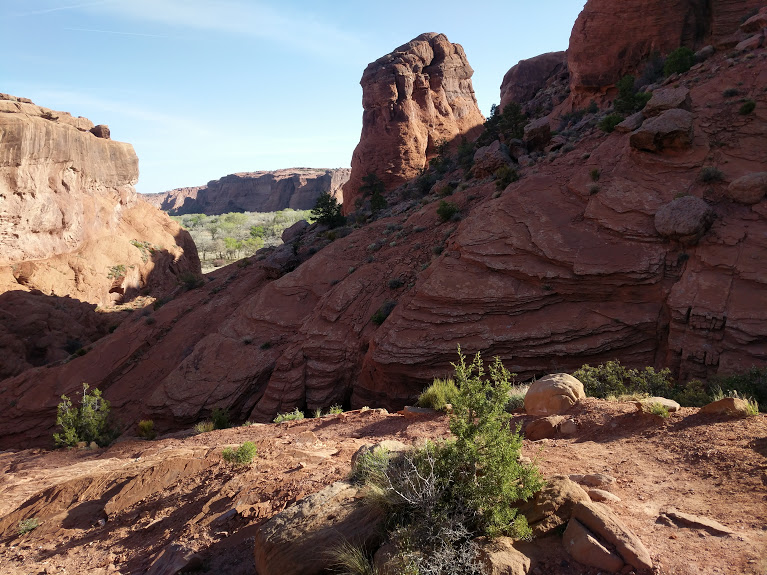
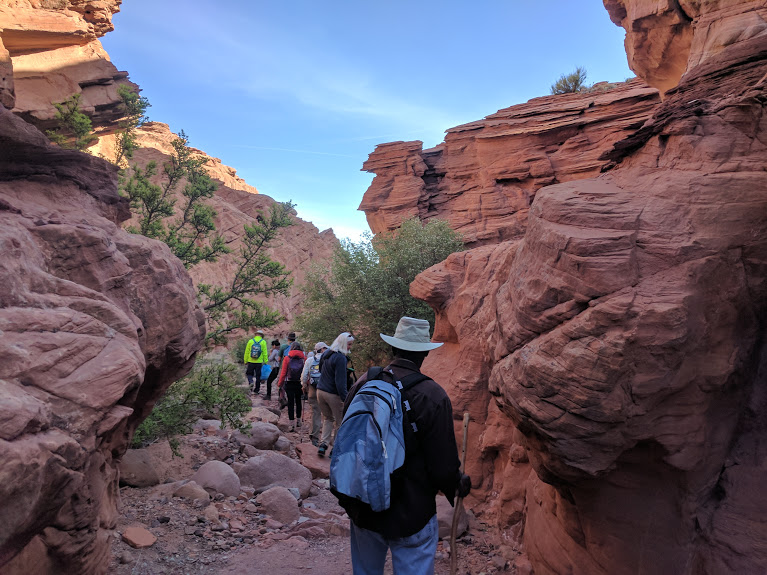
Devon is a local girl, just out of college and volunteering as a member of the SCA, Student Conservation Association. A short ride took us to the outlook and, following Devon, we strolled right by the ‘authorized personnel only past this point’ and down the rough rocky trail. Tunnel Canyon is well named: it is very narrow with high looming walls on both sides. After about half a mile and a descent of almost 300 feet we came out onto the valley floor. We climbed over an old-fashioned stile, a set of steps that went over a barbed wire fence. There we had the chance to take off our shoes and socks as we could be walking up the little stream. Chinle Wash, the waterway which runs through the canyon is called a ‘wash’ because it does not run all year. Even when the water is running, as it does in the spring, there is not a great deal of water. It is perhaps ten to twenty yards and shallow. And cold. We waded in water anywhere from an inch to a couple of feet deep. The bottom was sandy and it was easy to walk. Of course, there were occasional soft spots. Devon mentioned these were quicksand and that we should not stay in that patch for very long.
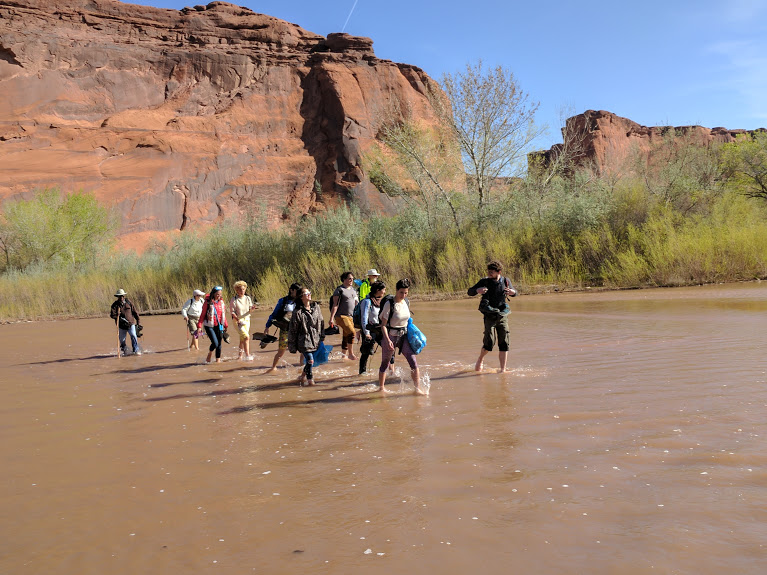

I was prepared; I had brought pants whose bottom legs zipped off leaving me with shorts. I had also brought some water sandals. I put my hiking boots, pant legs, and jacket (as it had turned warm) into my little backpack. Other members of the group went barefoot which was fine while walking in the soft river bottom, but less so when we got out to cut across a loop of the stream. Devon led us up the canyon toward our destination – the First Ruins.
There is only one way for wheeled vehicles to move up the canyon – Chinle Wash. Vehicles, all four-wheel drive, repeatedly passed us on the way in and out. Some were locals, going up to their property. Only a few ‘tough cookies’ as Devon called them, live down in the canyon year-round. There is no power and transportation in and out is dependent on the weather. It is not really practical to commute to work and you certainly wouldn’t get a school bus ride for your kids. There are several jeep tours that allow people to see more of the canyon from the bottom. All the while we were walking we had been looking for and collecting various bits of trash. After a couple of hours, we had two half-filled bags. Devon flagged down one of the jeeps and persuaded them to take the trash back out with them. Mission accomplished.
The First Ruins, so called because they are the first ruins you come to as you move up the valley are actually some of the most recent. They were abandoned about 1300 A.C. or so. The Navajos have a cultural proscription against entering a building where someone has died so the ruins were left in good condition. Devon explained that the ancient ones who built the pueblos preferred to live in close proximity to one another either for protection or to preserve flat land for crops. Further, in past eras the water in the canyon would often run from cliff to cliff and their pueblos needed to be high and dry. According to Devon, the Dine’, the Navajo word for their people, like to spread out more and live in their characteristic eight-sided hooghans (pronounced Hoe-gan).


We checked out the ruins from as close as the fence around it allowed and headed back down the wash. Devon was full in interesting bits of information. We learned the difference between pictographs, which are painted on rock faces and petroglyphs which are carved into the rock. Devon told us that Canyon de Chelly had more such art than any other place in the west. Most of them are small and in out of the way spots. She showed us several pictographs drawn in perilous places, high on the cliffs. The writers seemingly chose the most difficult and dangerous places to do their scribbling. I am sure they were made by young men. You can almost hear them say something like, ‘hold my beer and watch this.’ Okay, that may be a broad translation but I think you get my point. Not all the drawings were like that, though. Near the end of the hike Devon showed us some drawings that were much more recent. One group was by the Zuni, in their characteristic style. Some were old Navajo: two men were depicted on horseback chasing a deer. The old families claim that this was to honor medicine men who, when they needed a deer hide for their rituals, insisted the hide have no holes. So, they would mount up and chase a deer to exhaustion, then suffocate it so that the hide would be perfect.
We all exited the watercourse where we had entered three and a half hours before. We put on hiking foot gear and retraced our path, emerging from the canyon at noon. Taking a four-mile hike through spectacular scenery with good companions on a lovely spring day is a good way to spend a morning.
 TBLOG
TBLOG 