Canyon de Chelly – Sandy Hills Hike
My final hike in Canyon de Chelly was into Spring Canyon with Ranger Justin. I signed up for the scheduled hike into the canyon down the Sandy Hill trail and on to Spring Canyon on Friday morning. A co-worker/friend was finishing her time at the hospital on Friday. Ruth assigned me the job of picking up the farewell cake for one of her co-workers at 1130 on Friday to be brought back to hospital for the goodbye party. The hike was scheduled to be done by 1100. What could go wrong?
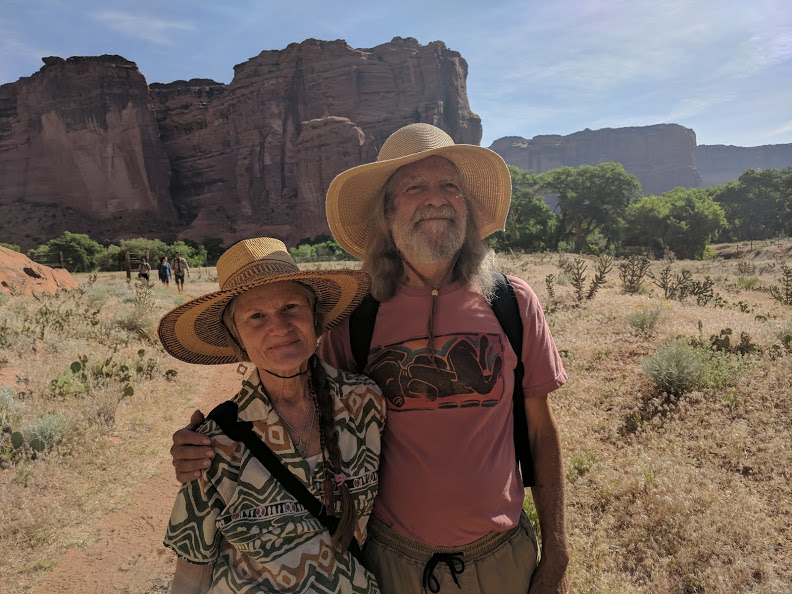
There were only five of us on the walk down to Spring Canyon, departing from the Sliding House Ruins lookout – a college professor and his recently-graduated daughter and a couple of itinerant musicians, Carl and Maryilyn. This couple, about my own age, had both been practicing musicians their entire lives. They turned a 24-foot Snap-on-Tools panel truck into a custom RV and set about traveling wherever the weather took them, playing gigs as the opportunity presented itself. I later had opportunity to listen to some of their music. You would think two life-long professional musicians would be pretty good – they are better than that- they are spectacular. You can hear them at https://www.facebook.com/carlandmarilynmusic/
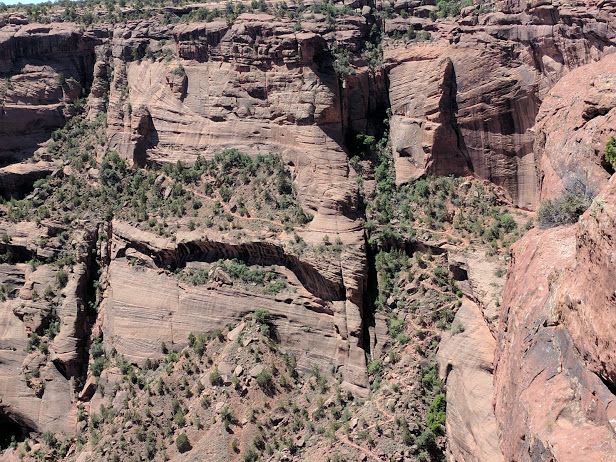
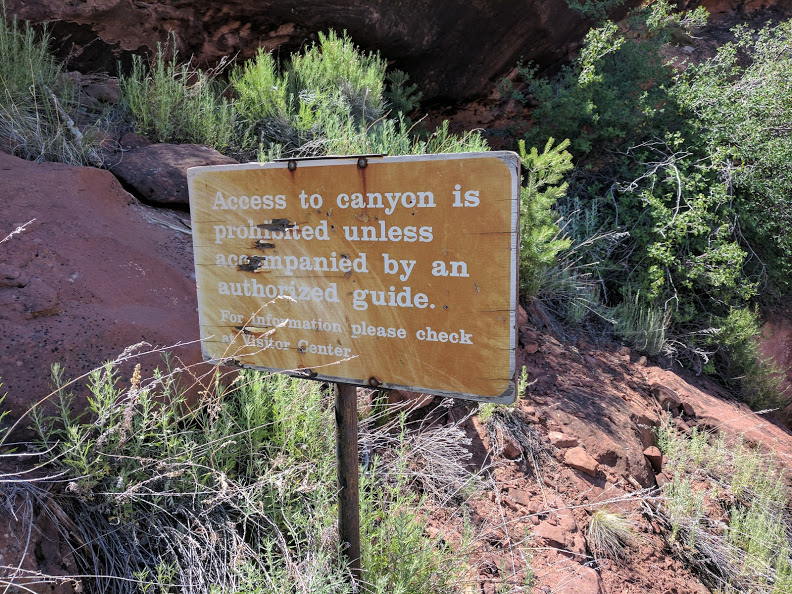
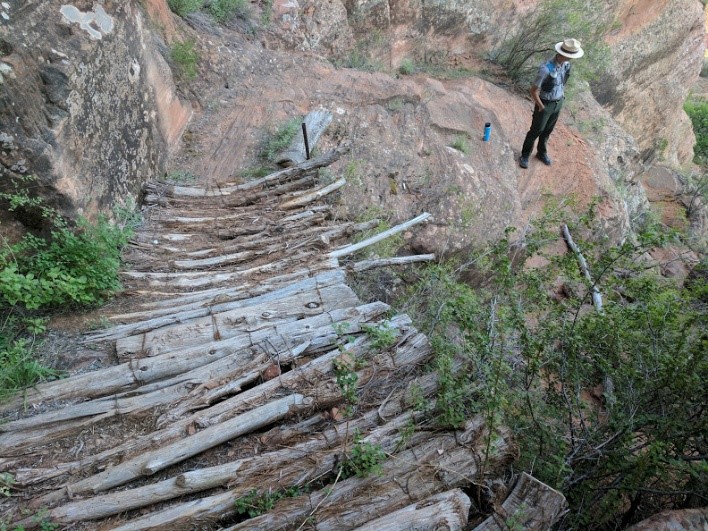
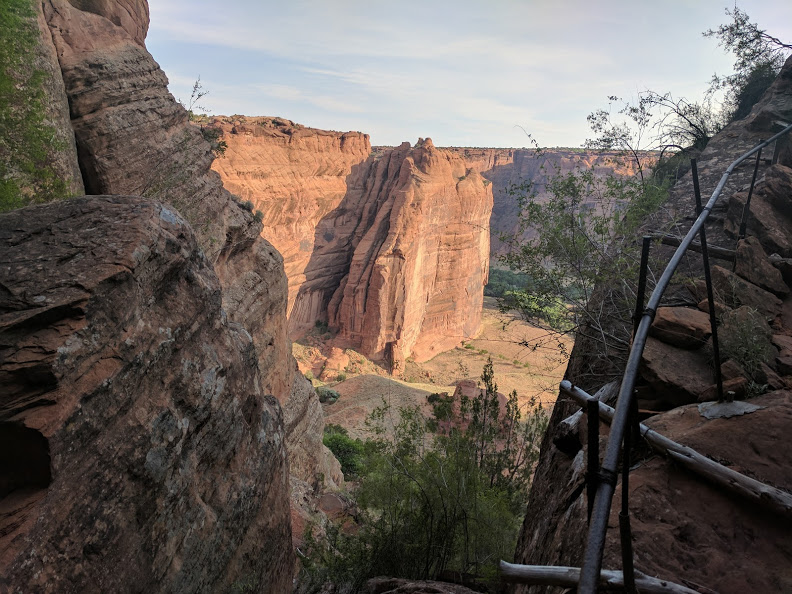
There is only one trail down into the Canyon that does not require a guide, and that trail is well-maintained. The others are not. In fact, they are sometimes rather alarming. There are ‘sort of’ handrails and little log bridges over some dips in the trail. Nor is the trail itself all that clear; this is one of the reasons why a guide is required. Another benefit of a guide is the chance to learn more about the geology, biology, archelogy and history of this complex and beautiful set of canyons.
We descended onto the floor of the main canyon and walked alongside the now dry Chinle wash. Spring Canyon, a significant side canyon opened up to the south. On the north side of the wash, portions of Sliding House ruins still cling to the north wall. These ruins were once the largest structures in the entire canyon. Now they are sliding down into ruin. Only a good look with binoculars can reveal what was once a complex of about 80 rooms. Within the Spring Canyon branch is another much smaller set of ruins. Perhaps because of the spring in this branch of the canyon the area shows signs greater signs of occupation than some. It also may be due to the sheer beauty of the site.
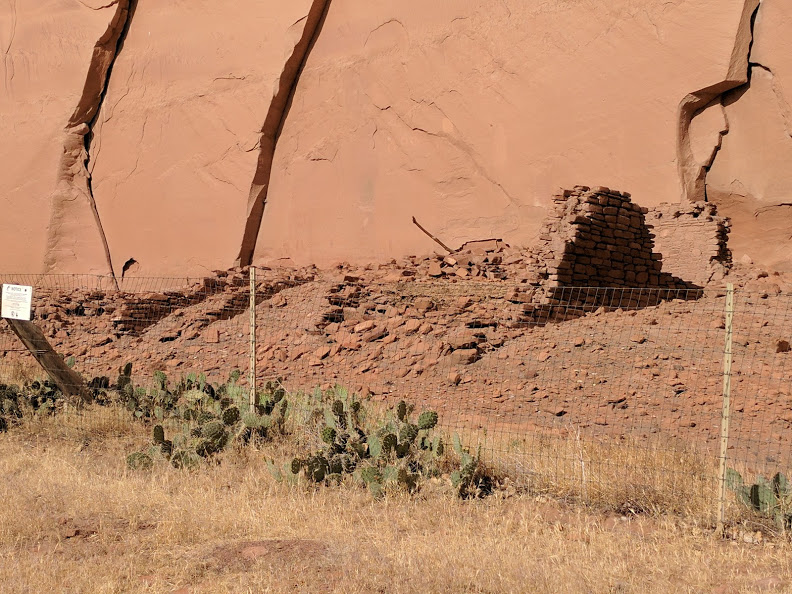
We did not go close to Sliding House but instead cut over to the Spring Canyon site which is now just a few walls of sun baked mud bricks with only a few walls left standing. One of the recurring things that have struck me in my trips into the canyon is how transitory our civilizations are. People have lived more or less continuously in this canyon for over four millennia; you can feel it, yet little remains. Not only people live in the the canyon. We had stopped to look at the tracks in the sand track at the edge of the wash. There were horses, deer, raccoons; the expected animals. Then Marilyn’s keen eyes picked out a clear track of a very large cat. Puma as well as bear live in the canyon. The rangers have received reports of one being seen not far from where we found the print in the sand. The canyon may be inhabited but it is still wild.
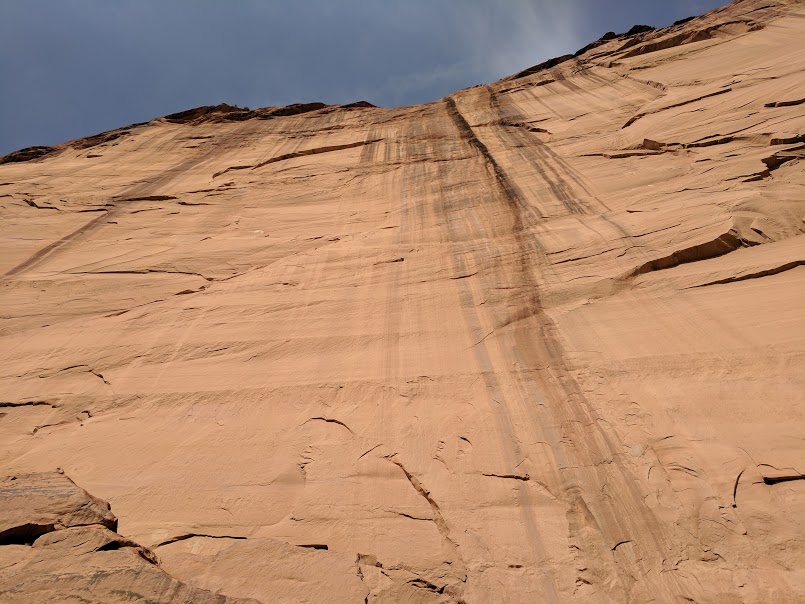
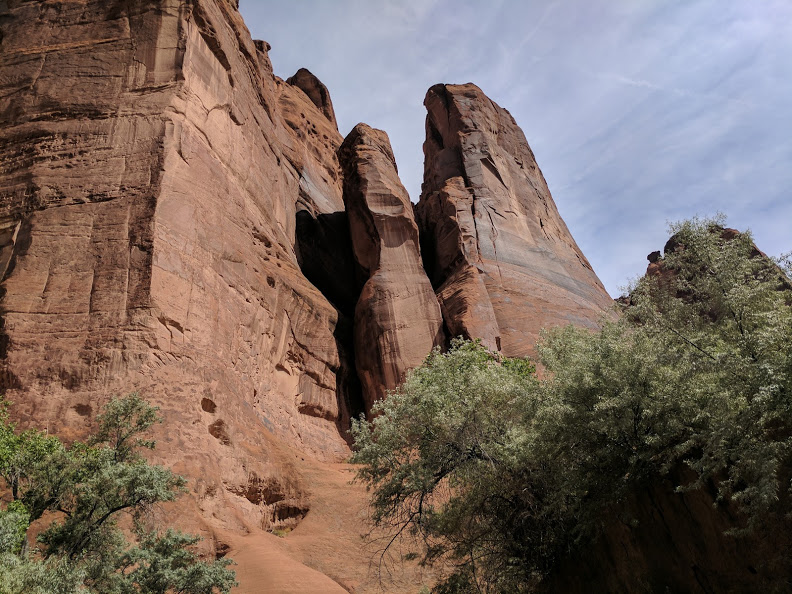
We crossed over a barbed wire fence on a metal stile and walked further into Spring Canyon. The sheer walls reach over you, past the vertical in some places, and are so smoothly huge they are positively disorienting. You can walk right up to a sheer wall in Canyon de Chelly and put your hand on a stone face that goes straight up for hundreds of feet. It is unlike the feel of a building; you can just feel the incredible mass and solidity that is lacking in any man-made structure.
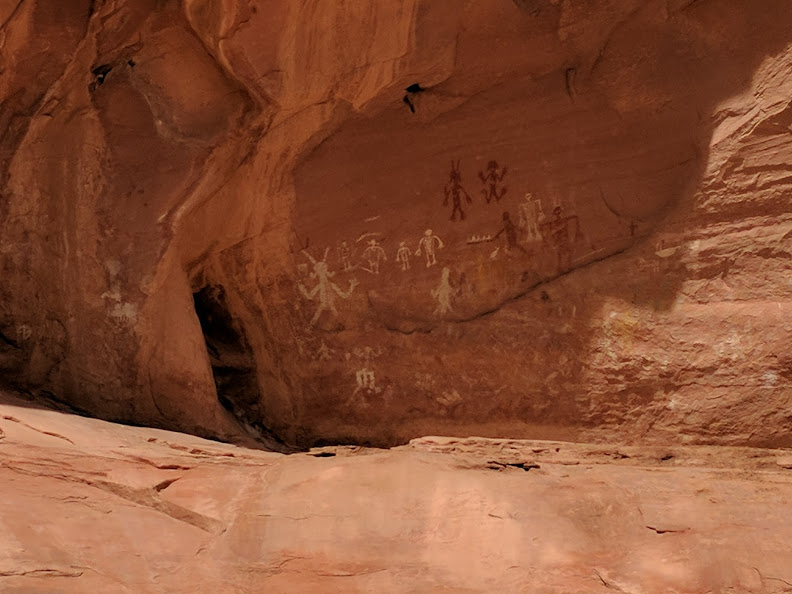
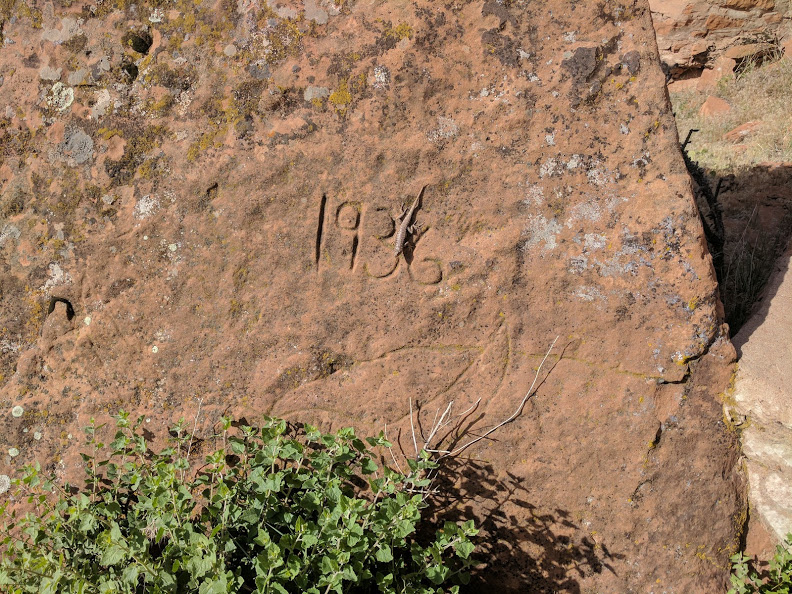
There are not only a lot of ruins in the Spring Canyon area but there are also many pictographs. This rock art is a reminder of people who lived here over a thousand years ago. Now all that is left are a pile of sun-dried bricks protected by a fence, a sign, and the forbearance of the Navajo. The water from the spring at the end of this branch of the canyon was partially dammed by the old Civil Conservation Corp in 1936 as the inscription on a rock indicated. The granite and concrete dam had fallen into ruin as well. The timescale within the canyon is huge – millions of years. Human habitation there stretches back millennia. The remains of a small dam are hardly noticeable.
There were not many of us on the hike and Justin had plenty of time to tell stories. So many stories that we were 30 minutes late getting out of the canyon. Yikes, I had to go get that cake. I was lucky enough to pick up the cake and get it to the hospital just in time for the farewell party. Whew.
This was my last walk into the canyon. I was lucky enough to walk down five trails into the canyon, four of them guided. There are hundreds of trails in the canyon; some of which I am physically unable to use. There are tales of even Navajos, who as a rule are unaffected by heights, freezing on some of the rock faces. It takes a lifetime to really know this canyon and all of its secrets.
Canyon de Chelly was an unexpected pleasure. I recommend a visit to anyone willing to make the hundred mile long detour up from I-40. It is both awesome and accessible; vast but not overwhelming, and stunningly beautiful. Erosion made the Grand Canyon but God made Canyon de Chelly.
 TBLOG
TBLOG 