Canyon de Chelly – White House Hike – April 2017
Canyon de Chelly National Monument is located just outside of the small town of Chinle where my wife Ruth would be working at the hospital for three months. We took advantage of the situation to visit the canyon before Ruth started her job. I discovered that the ‘ch’ is pronounced like the ‘ch’ in Chevron, so that it pronounced ‘Canyon de Shay’. It is from a mispronunciation/mistranslation of the Navajo word Tseyi’(pronounced Say-it). Tseyi’ is the Navajo name for the canyon. It literally means ‘between the rocks’.
I did not know much about the canyon which turned out to be a good thing as it made the canyon even more impressive. The Canyon de Chelly is an abrupt slash in the rising flat scrub land around that reaches out east of Chinle. After a brief stop at the small visitor’s center we headed up the two-lane road that ran a distance south of the canyon. We could see 30 foot high red cliffs defining a flat narrow canyon. The road along the southern side of the canyon moved away from the rim for a mile or so and continued to climb. We stopped at the first real overlook and found the cliffs on either side of the canyon had grown to 100 feet high. Most impressive.
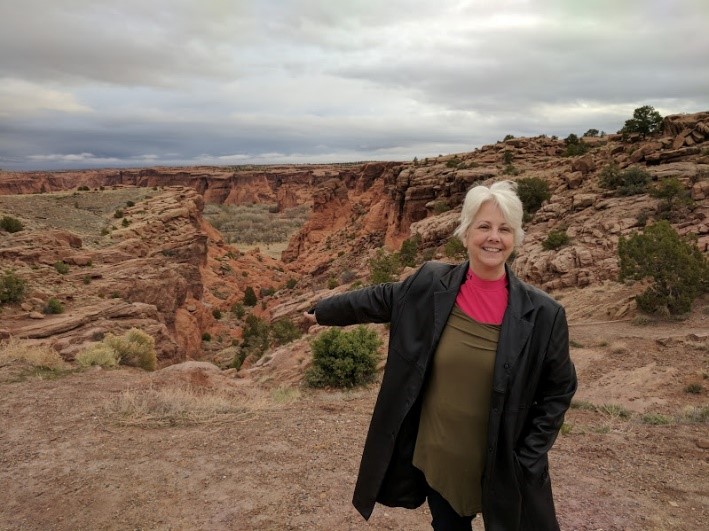
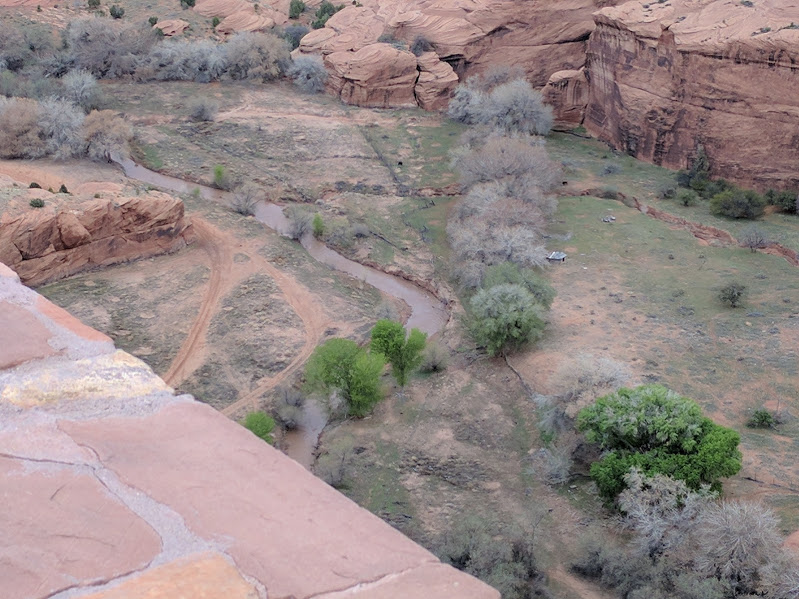
A small, shallow watercourse, Chinle Wash, nourished grass and some scattered trees and shrubs gave the canyon a fertile aspect, at least compared to the surrounding countryside. A few miles further up the road we came to another turnout where we could see the canyon again. The walls had risen dramatically to well over three hundred feet. And so it went as we drove up higher and higher until at the last overlook on the south rim we were looking at huge red cliffs of almost 1000 feet high. They were more than just sheer; in places, the cliffs actually swept back past the vertical, giving the impression of a gigantic red rock wave about to crest; most impressive. Far below we could see tiny structures and even small corrals and fields.
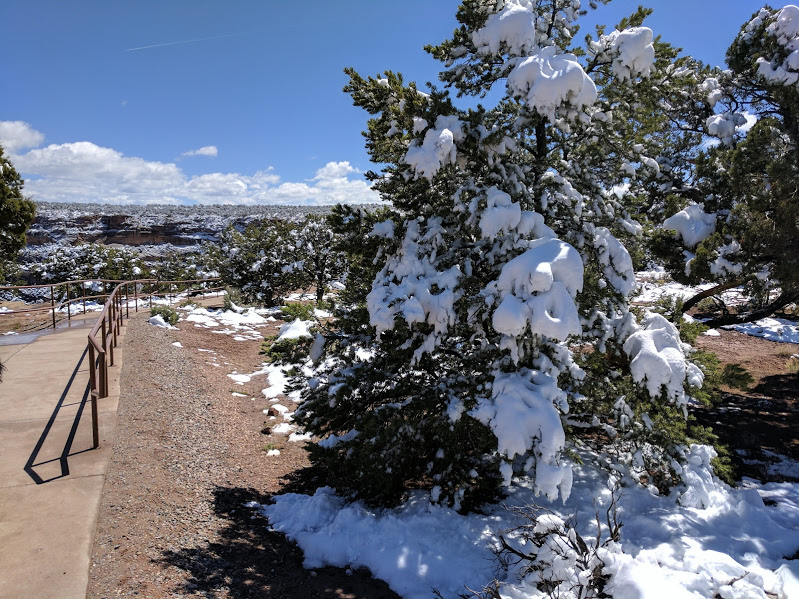
We completed our tour of both sides of the Canyon on Monday before noon since rough weather was predicted, both by weather reports and by anyone who looked up at the gray, threatening skies. By dark we were tucked into our little motel enjoying the security of a warm room. On Tuesday morning, Ruth’s first day of work, we awoke to a delightful blanket of fluffy power snow. What joy! I hadn’t seen snow on the ground in years. This was the perfect kind; not too cold and obviously going to melt before anyone could even think to grab a snow shovel. After dropping Ruth off at work, Oliver the Wonder Service Dog and I took another tour of the north rim of Canyon de Chelly to get some more views of a snowy canyon.
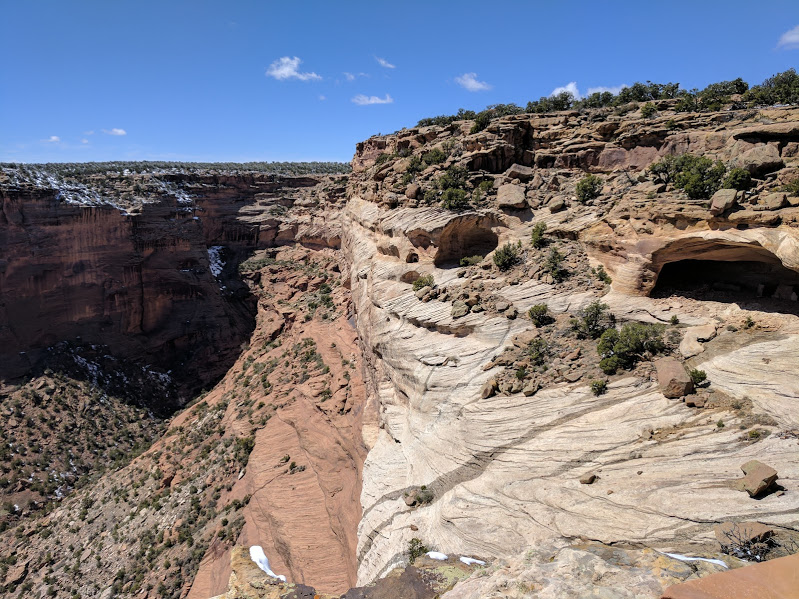
A view of Massacre Cave on the northern rim of the canyon
The views were spectacular. Massacre Cave was named for a slaughter of Navajo by the Spaniards who trapped a hundred of them on a ledge in 1802 and shot them down.
Interestingly, the snow picked out just how many houses there are on the upper sides of the canyon. The canyon and all the lands around it are part of the Navajo reservation. People live all around the canyon and a few even stay in traditional hooghans down on the floor of the canyon. The homes were mostly those of the rural poor with a lot of trailers and manufactured homes mixed with a few hooghans.
On a bright cool the next Sunday afternoon, I decided to take the only trail down to the floor of the canyon that does not require a Navajo guide. The White House trail is only a round trip of 2 ½ miles round trip, but it does involve a vertical change of about 600 feet. This was confirmed not only by my fancy wrist watch/altimeter but also a handy warning sign about the cliffs.
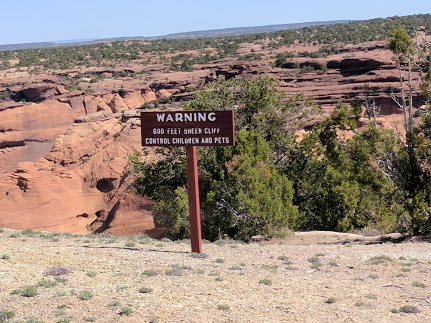
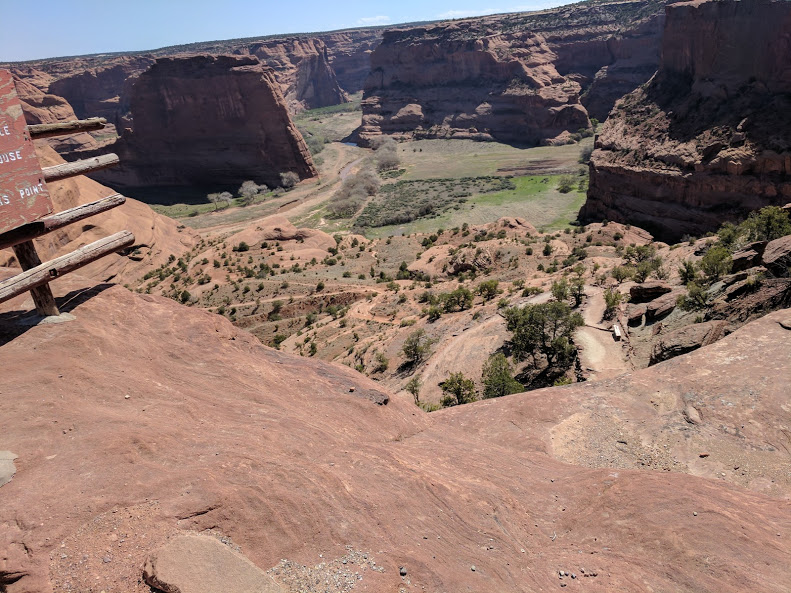
Unlike other trails I have hiked, this trail was often over hard rock, sort of like walking on pavement. Of course, with my talent for getting lost I was a bit concerned. I need not have been; the trail was just about the only way down, short of a steep drop. There were plenty of places where an unwary step would have pitched you over a very long way. The first of two tunnels, blasted through the rock in the 1930’s to allow hikers to get down the steady zigzag trail. Near the bottom was a final narrow passage about fifty yards long, just wide enough for two people to walk past one another.
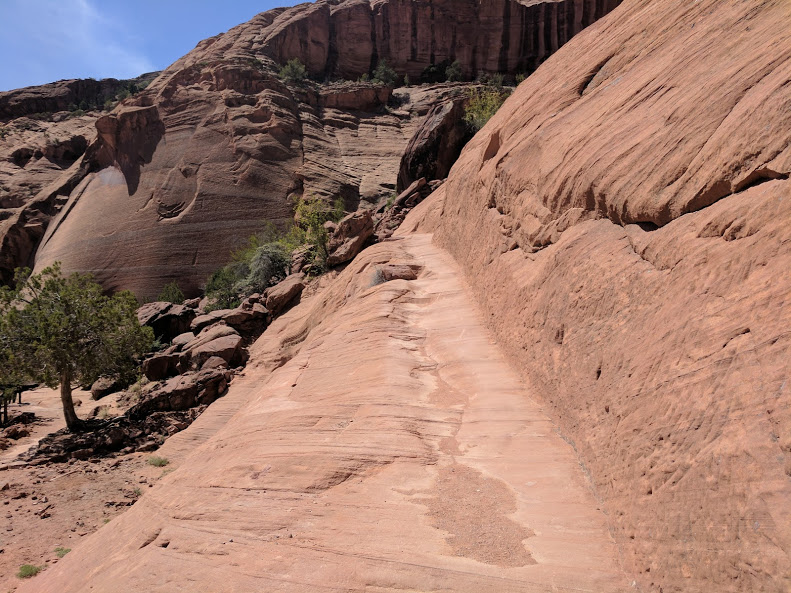
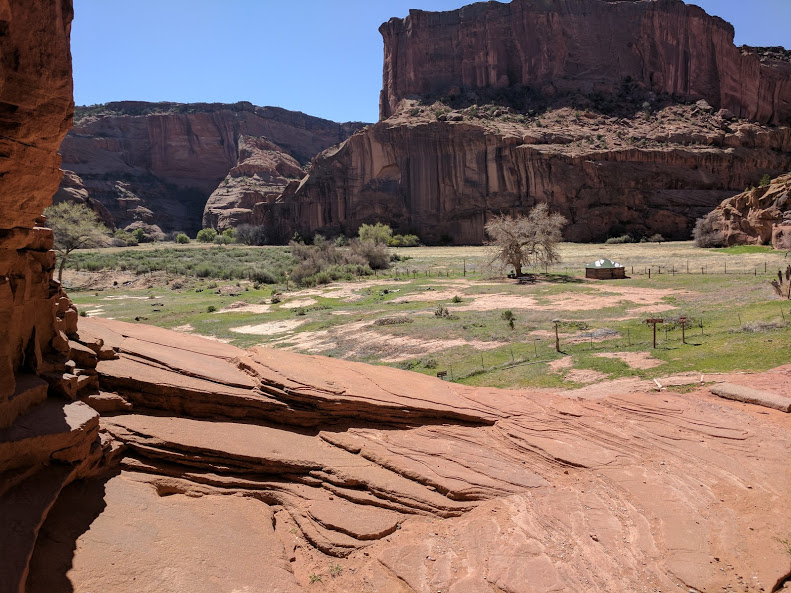
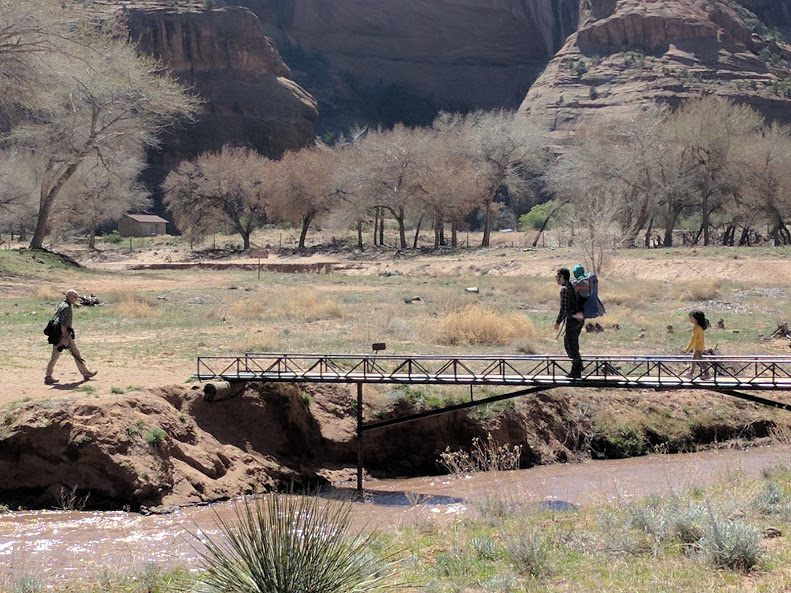
Coming out through the lower tunnel I divulged onto the floor of the canyon, not far from Chinle Wash, the periodic stream that runs through the canyon. People live down here. There was a green roofed hooghan behind a fence that proclaimed, ‘no trespassing’ and that photographs were not permitted. A right turn led down to the river, in full spring spate. A charming little foot bridge led over the rushing stream and across the floor the canyon down to the white house ruins; a set of typical pueblo structures located up against a looming cliff.

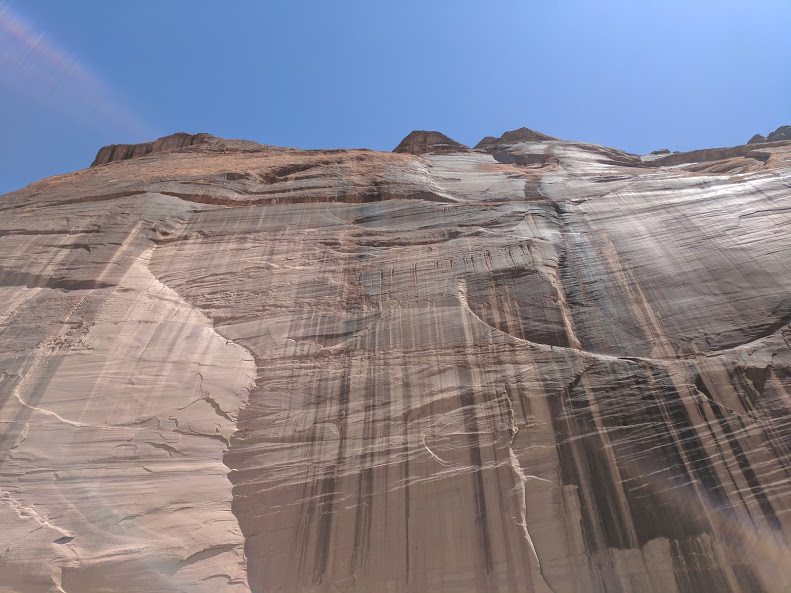
Make no mistake, these were genuine cliffs. Walking around modern skyscrapers in a big city gives a small taste of what it feels like up against these massive rock walls that tower over your head. They gave me a strange feeling of security. These walls would protect the floor both from the weather and enemies. They also channel the water; this is a relatively verdant spot in an otherwise arid region. That may be why there are indications that the Canyon de Chelly has been occupied for around twelve thousand years. This was the center of Navajo life until the US Army, under Kit Carson swept through it in 1863, destroying the crops, houses, and cutting down their peach trees.
There are still about 80 families that live in the canyon, without electricity or running water, preserving the traditional Navajo ways. They do not care to have their photo taken without permission or to be more specific, without paying them a fee. These people can use the money.
I checked out the ruins; not much, they mainly provided an excuse to walk down into the canyon. It was time to make the climb back up the trail to the car. No problem, just keep walking up the stone path the equivalent height of a 60-story building. The hike took me about an hour and a half. One of the things I most appreciate about the climate in Arizona was that even though there were times when I was a bit warm and was sweating, in the dry air it evaporated immediately, doing its cooling work. This was a pleasant change from my experience in east Texas where I would be dripping sweat.
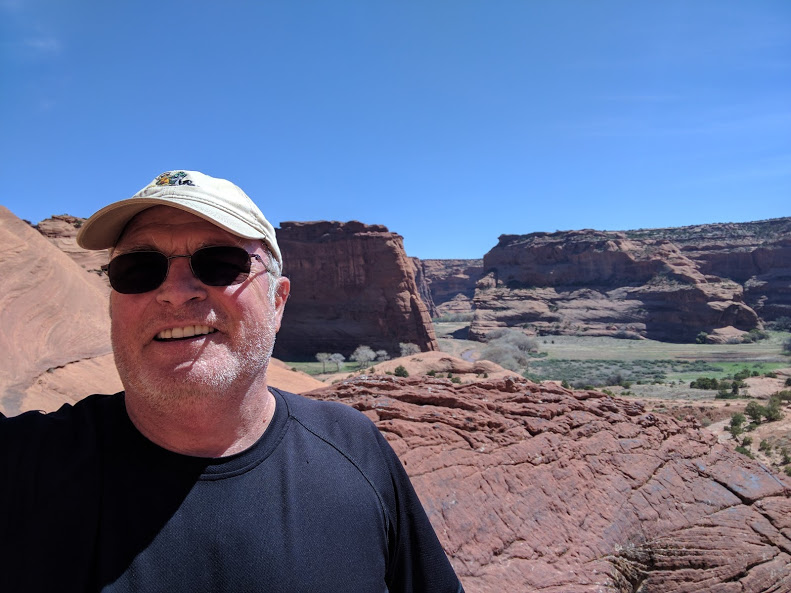
Canyon de Chelly is a truly remarkable and impressive sight. It can be experienced in a single day and is well worth coming to see. There are jeep tours and horseback guided tours into the canyon if you want to explore it even further.
 TBLOG
TBLOG 
I did a jeep tour n the 1980s. Amazing place. Loved Spider Rock too!
LikeLike