Visiting Machu Picchu – June 2014
I agreed to go on a mission trip with my church to Lima Peru in order to learn more about culture, do good works, and deepen my own faith. I was offered the separate opportunity to go on an excursion after the mission trip to visit the Incan ruins at Machu Picchu. It did not take me long to decide that it was worth the expense. After all, I was about as close to being ‘in the neighborhood’ as I was likely to get. You do not ‘pass through’ Machu Picchu on the way to anywhere else. In fact, it is located about as far out into the back end of nowhere as it is possible to get. That is part of the attraction of the place. Five of us signed up for the package: Jamie and Tammy, Linda, Laura, and myself, all members of Lord of Life Lutheran Church in The Woodlands, Texas.
First, I should give a brief overview of what makes Machu Picchu so special. When the Spanish conquered the Incan Empire the empire stretched from what is now Columbia all the way down to Chile, with a population of more than 15 million people. The Incan capitol was in what is now Cusco (or Cuzco in Spanish), deep in the Andes Mountains. Cusco is high, over 11,000 feet, so it gets cold in the winter. Around 1450 the Incan emperor decided he wanted to winter somewhere a bit warmer. They found a site about 50 miles away and three thousand feet lower down with good water, a place to quarry granite, and spectacular views, so they build what was essentially a winter palace for the emperor. After Cusco was captured by the conquistadors about a century later the Incan emperor took refuge in Machu Picchu for a time. Realizing the Spanish would eventually find him there he abandoned the location and retreated deep into the Amazon jungle. Of course the Spanish eventually found and executed the emperor, but since there was no need to go to the abandoned city they never went there. Instead the jungle quickly reclaimed it keeping it hidden from the rest of the world until 1911. That makes it a relatively intact cultural site, virtually unique in all of South America.
Our tour package included all transportation, admissions, and dedicated guides. They arranged to pick up at the ‘magnificent’ El Mirador Hotel and convey us to the Lima airport to catch an early (0600) flight to make the ~300 mile trip to Cusco. Since traffic through Lima is slow and uncertain they told us they would pick us up at 0300. We figured that with Peru time that mean sometime around 0330 which still gave us plenty of time to get there.
I was quite surprised when the hotel manager knocked on our door at 0145 telling us the bus was there to pick us up. Yikes! We were pretty much packed up and ready to go but instead of being awake and ready we were all asleep so it took us half an hour to get loaded up. We drove through the silent streets of Lima arriving a good two and half hours early for our flight. The Lima airport is a perfectly functional and efficient structure; it is also drab and boring – not a place you want to hang out. But we were excited – we were off to an adventure to see a legendary place, one of the seven wonders of the modern world. Soon enough we were boarding our Peruvian Air 727 for the one hour flight east into the Andean jungle.
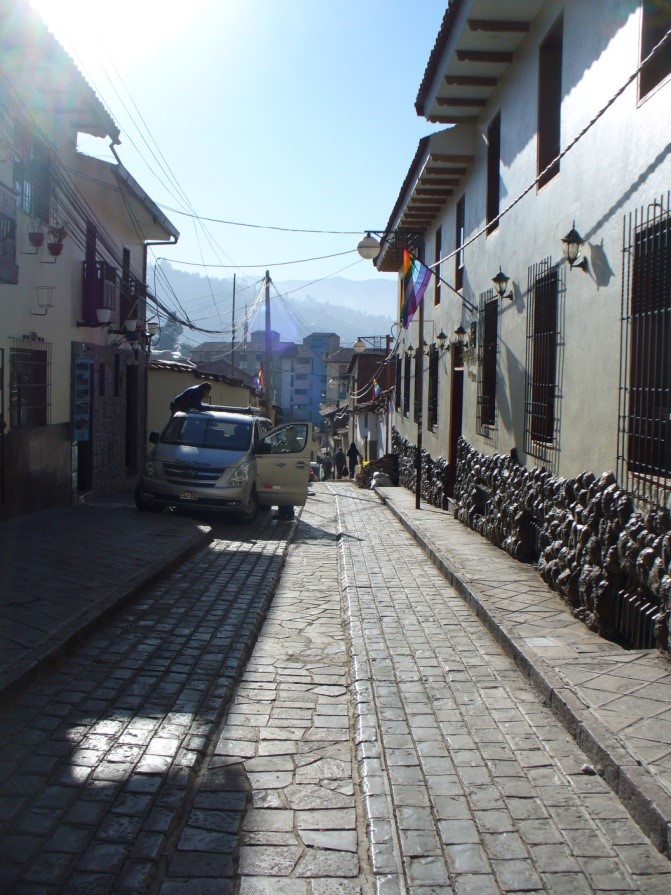
We were met at the small Cusco airport by a local driver Freddie who held a sign ‘Houston Group’. Close enough. Cusco is a charming city of about half a million people high in the Andes Mountains. Freddy led us to our Tambo Tours Guide, Paul (pronounced Pa’ule). Paul was a cheerful man, well versed in the history and culture of the Incas and the Spanish that conquered them. Paul explained that the Spanish tended to destroy many of the buildings in the Incan Empire, especially the religious temples. The Incas build so well with stone that to this day you often find buildings with the first meter or so composed of Incan stonework with more recent structures built atop them. There were many truly impressive ruins there.
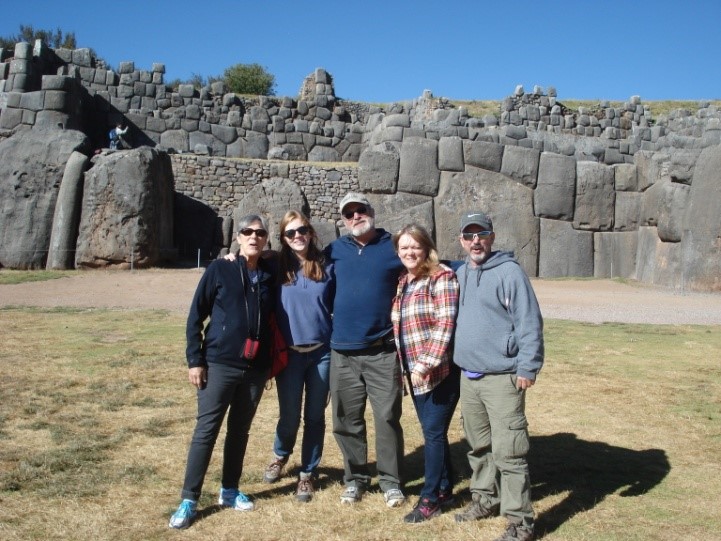
Sacsayhauman Park is a massive complex of stonework where the Incas would parade defeated tribal leaders to demonstrate their power and stone craftsmanship. We toured through the impressive buildings for an hour. Calling them buildings does not do justice to these massive stone structures. We toured the enormous stone amphitheater of Kenko which enclosed several acres of grass. I was most taken by a set of stone slides that must have been used just for fun. Laura and Paul demonstrated for us by sliding down. I passed, feeling a bit light headed from the altitude although I did not get altitude sickness as poor Jamie did. He stolidly soldiered on despite feeling like he was badly hung over. We also went inside several sacred sites including one that was said to enclose a stone said to be a source of power. The place was quiet and peaceful – a proper spiritual place. I took a moment to put my hand on the stone and pray.
We loaded up in the tour company’s van and headed down the sacred valley of the Inca passing by steep mountains that had been painstakingly terraced by centuries of patient work by literally millions of Incas. The Incan Empire was essentially a totalitarian theocracy; everyone worked for the state and when I say ‘worked’ that is what I mean. That was how you paid your taxes. The work was not just building temples and palaces. A lot of that work involved turning steep hillsides into terraces that could be farmed. These terraces were in some places only a dozen feet wide, row upon row of them stretching up the mountainside. Granaries were built to hold the surplus. It was all very efficient, especially considering they were pre-literate, had no draft animals, no wheeled vehicles and only simple bronze crowbars. What they did have was many hard working peasants and time.


We continued down the sacred valley, stopping at a local animal sanctuary where there were various regional animals that had been rescued such as llama, alpacas, pumas, condors, parrots and vicuna. Interestingly, vicuna are so aggressive that they must be kept separate from the other animals. The Incan religious beliefs were that there were three realms: the upper, symbolized by the condor, the middle represented by the puma, and the lower which was the anaconda. They had several condors there in a large enclosure and some were encouraged to fly over us. They are genuinely large birds, although far from attractive. I presume that they looked more imposing when hovering high in the clear Andean sky.
We drove on passing astonishing ruins such as Olantaytambo which was a massive fortress with associated terraces and silos. We saw wonder after wonder as we passed down the valley. The thing we most appreciated however was lunch. The five of us had not sat down to a good restaurant in over a week and when Freddy took us to a lovely resort with pavilions set up on the grass, live Andean music, and a nice buffet, we enthusiastically dug in. After a wonderful, relaxing meal we continued on down the valley, mountains rising on either side. Paul pointed out a river below us which flowed into the Amazon, ultimately ending up into the Atlantic Ocean many thousands of miles away.
Eventually all good trips reach their destination. Paul and Freddy left us at the train station at Ollantaytambo where we caught the train to Aguas Calientes, deep in the Andes and only a few miles from Machu Picchu. The trains and the station at Ollantaytambo felt more like some sort of amusement ride than a railroad. Okay, a pretty seedy amusement ride; I noticed that there were no seats on the toilets in the station, a fact confirmed by the distaff members of our group. Apparently, that is not uncommon in Peru. Each car had its own engine beneath the car making them seem more like linked streetcars than a proper railroad. We took our assigned seats for the one and a half hour train ride down through spectacular scenery – a lovely mountain river to one side with steep cliffs on either side rising to snow-covered Andes peaks. It was all very nice – until it got dark, then it was rather boring.
We arrived in due course at Aguas Caliente and were met by a man who led us a short distance to our hotel; a real hotel, with shower curtains, and soap, and full-length beds. Instead of dogs and roosters the only noise was that of a rushing stream right outside the window. That evening the five of us wandered down the walkway along the river looking for a place to eat. The town is built on tourism so there was a wide range of choices. The offer of a ‘free pisco sour’ lured us into a pizza place. Pisco sours are the Peruvian cocktail of choice and pizza is rapidly becoming the global standard in tourist food. After dinner we met briefly with our guide for the next day, Rau. He advised us to catch an early bus up to Machu Picchu so that we could beat the crowds and more importantly watch the sun rise over Machu Picchu. It sounded good to us so we went to bed early.
It was a good thing we did as we were up at 0445 in order to get dressed, eat, and make the short walk to the bus, arriving around 0530. Buses had already begun to depart. Even though it was the day before the winter solstice (20 June – we were south of the equator) the sun had begun to lighten the sky by the time we boarded one of the steady stream of buses that were heading up the narrow mountain road to the ruins. When I say narrow, I mean so narrow that in places buses had to back up to a slightly wider place so that buses coming down could squeeze by. The road climbed steadily, switching back 14 times. There was a significant drop on my side, giving me a splendid if somewhat scary view of the river far below. Of course, there is no word in the Peruvian lexicon for ‘guardrail’.
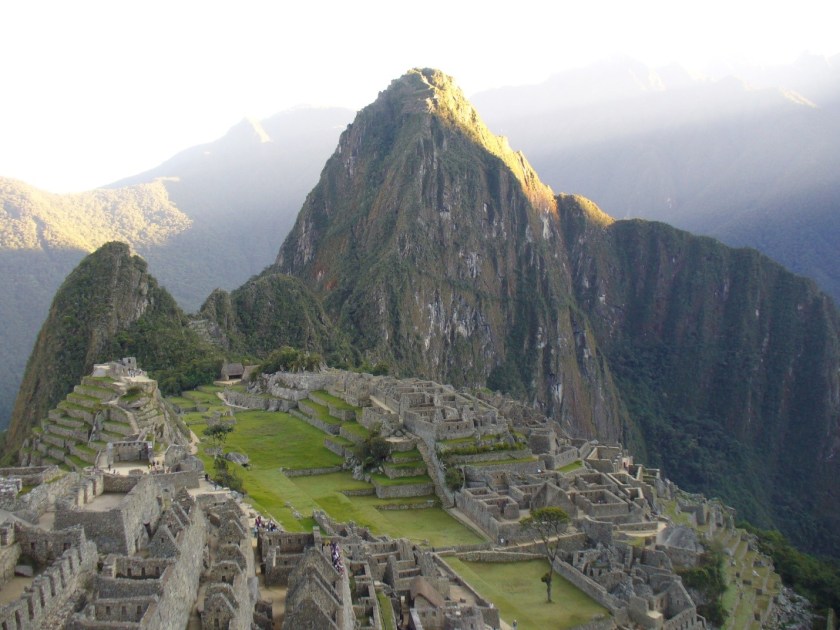
We arrived at the gates of Machu Picchu at about 0645, half an hour before sunrise. After passing through the gates (again with overtones of an amusement park) we walked up the rough hewn steps to the first of many spectacular views of the ruins of Machu Picchu. Above us was an ancient guard house. Before us was the famous smaller sugar loaf peak called Huayna Picchu (Young Mountain) with Machu Picchu (Old Mountain) looming up behind us. The sun was still well behind the peaks to the east but there was plenty of soft light filling the site below.

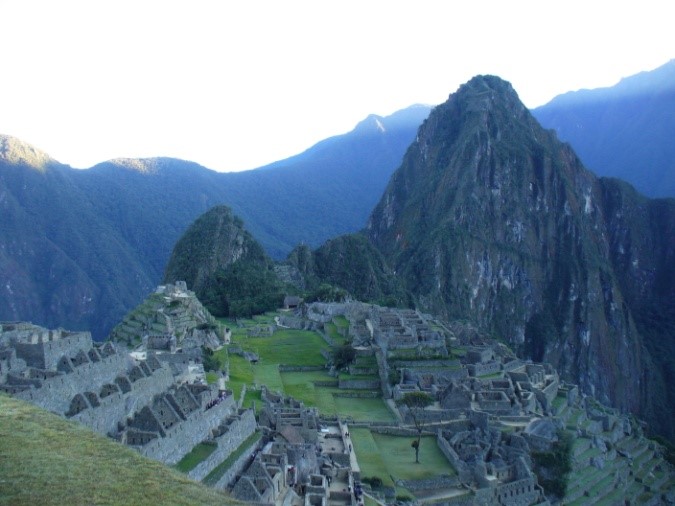
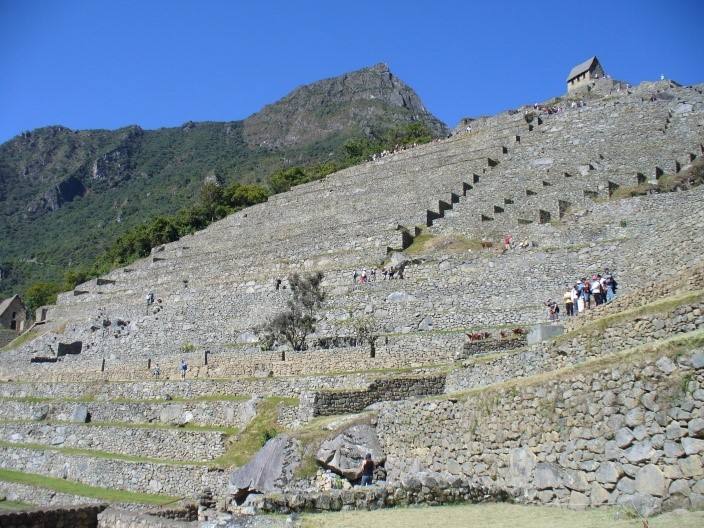
We watched the sun slowly climbing up until the beams illuminated the site below us. The day was perfect – cloudless, cool, and dry. Together we walked back to the entrance to meet our local guide, Rau, a Quechuan Indian. We came to call him ‘the last Incan’. He most certainly identified with the peoples who had constructed the +200 stone buildings spread out below us. Rau showed up the route we would take all the way down and across to the start of the trail that climbed up Huayna Picchu and back again. There are no ramps in Machu Picchu; if you wanted to go somewhere you going to walk up and down steps. These were not modern regular steps; they tended to be just a bit off in rise and run so you really had to pay attention to where you were putting your feet. This is surprisingly tiring.
Off we went down the terraces and into the complex. The ‘winter palace’ had about two to three hundred full time residents who farmed and maintained the place. It is hot and rainy from October to April; that is not when you want to be there. In the dry season when the emperor came to stay the population of the place more than doubled. There were places for the common people to stay and slightly nicer homes for the priests and upper class. There were also granaries, temples and other miscellaneous structures. But there were no grand palaces, no huge temples or enclosed places for crowds to gather, or even streets; the Incas had no draft animals and no wheeled vehicles. Nor did the Incas have any furniture; or doors for that matter. Even the emperor sat on the ground with a hanging across the entrance. Of course, he sat on intricately woven rugs with elaborate hangings on the wall but it was still very different than anything in Europe or Asia.
We were fortunate to be there on the day before the winter solstice. The Temple of the Sun had two sets of slits that lined up with carvings on the rocks within at dawn on the solstice. We followed Rau around the site for the next four hours as he explained what the structures were, how they were built, and about the Incas and their beliefs. Tammy was decided she did not want to go up and down so many stairs, especially at 8,000 feet above sea level. She waited for us while we tramped down to the far end of the ruins. She and Jamie then decided to go back to Agua Caliente while we explored a little further.
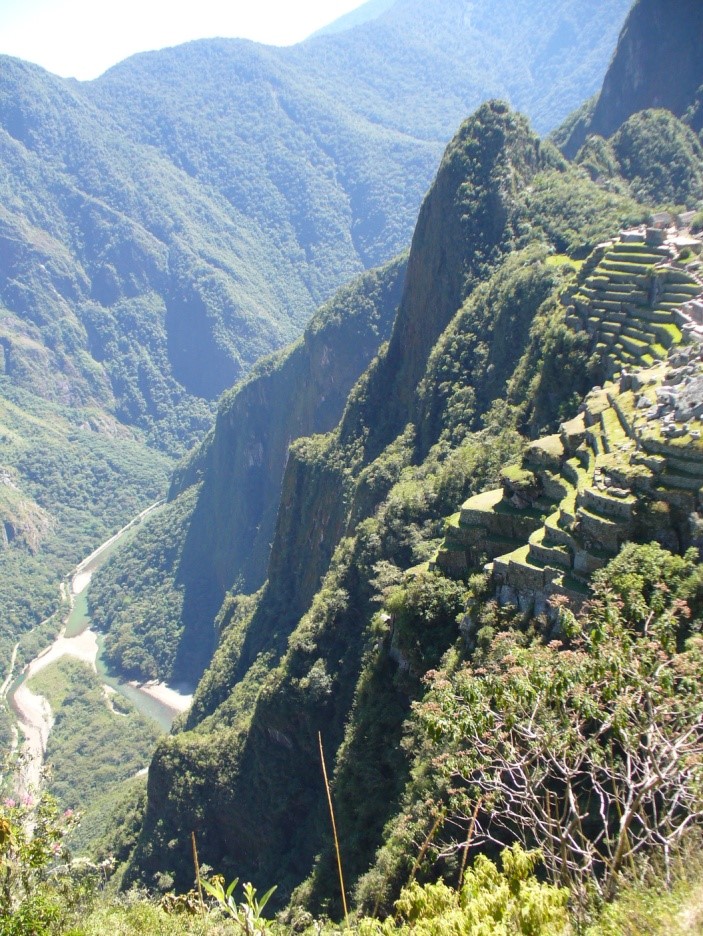
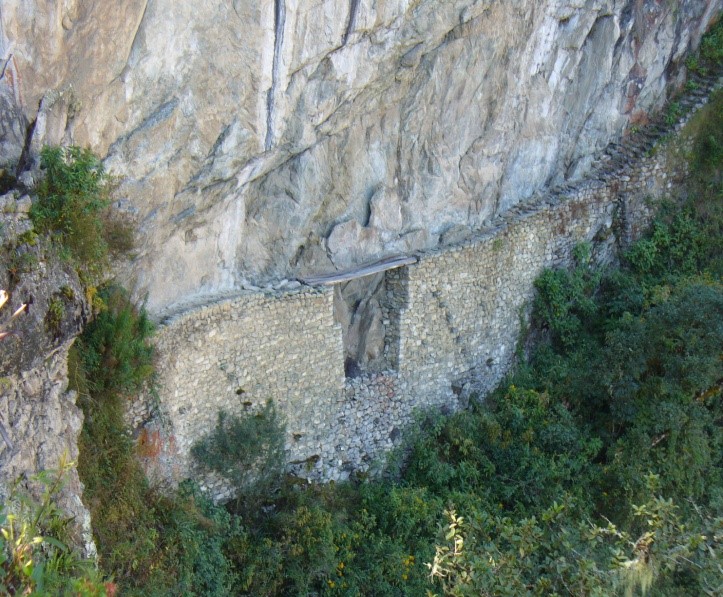
After Rau finished his tour Linda, Laura, and I walked around the long path on the backside of the mountain to see the Inca Bridge. When Machu Picchu was abandoned legend says that the last emperor was carried on his golden litter out this back trail and down to the jungle. The trail quickly narrows and runs alongside some seriously steep cliffs. It eventually leads to the famed bridge which appears to be just a couple of thick planks over a gap in the trail. The trail itself is cut in places out of the side of a mountain that ranges from extremely steep jungle-covered slopes to sheer cliffs. It is not a walk for those afraid of heights. The trail comes to a merciful end just short of the bridge itself.
We left Machu Picchu well after lunchtime, stopping to retrieve our backpacks which contained much appreciated snacks. Then we braved the perilous bus ride back down the mountain to Agua Caliente. We had a very nice lunch in one of the many cafes in town and did some light shopping before catching the 3:20 train for the hour and a half train ride back to Ollantaytambo. The ride back was enlivened by a fashion show of sorts. The train attendants who had brought us our refreshments modeled some of the fine shawls, sweaters, and other wool products that they sold aboard the train. The quality was high; so were the prices. The trip was also enlivened by the sudden and somewhat alarming appearance of a man dressed as a demon in outlandish ceremonial garb, complete with a fierce black mask. The Winter Solstice is apparently an occasion for local traditional festivities. He danced up and down the center of the car to lively piped in Peruvian music. Then he persuaded some of the riders (including Laura) to join in the dancing.
We were met at the terminus by Freddy who drove us back down to Cusco. Unfortunately, the city was having a celebration and many streets were blocked off. It had been a long day and we were all very tired by the time we got to our hotel. Linda and Laura persuaded me to go out to eat with them. We walked to a nearby restaurant that had been recommended to us, arriving just as the fireworks show began. We dined in the continental fashion, starting late and taking our time. The meal was wonderful; Linda had alpaca which was tender and delicious. We also shared a couple of pitchers of Pisco sours which, combined with an arduous day, high altitude, and fine dinner made sleep easy that evening.
The following day was almost all travel. We took a stroll around Cusco after breakfast then were picked up and delivered to the airport for the flight back to Lima. We arrived in the dreary Lima airport shortly after lunch and then had to sit in the airport until the United terminal opened at 2100. Once we were checked in we all had dinner in the much nicer international departure lounge where we waited until our flight left for home shortly after midnight.
Our excursion consisted of two days of intense wonder and one long day to return home. I am very glad that I had the opportunity to see the marvelous ruins. I understand why they went undiscovered by the outside world for so long. They are truly in a remote site – a long way from anywhere else and difficult to reach. The terrain on the eastern side of the Andes is literally fabulous, with rugged mountains covered in heavy vegetation. The area is also very beautiful, and the people friendly and welcoming. I was fortunate in my traveling companions who were patient and kind; I would travel with any of them on any adventure anywhere. Peru left me with one final gift. I took a few bites of the provided salad on the flight home which included some lettuce – locally prepared lettuce. Sure enough the next day I had a mild case of the dreaded sit down illness that we had all done so much to avoid. Mine was very minor and I was in my own home with nothing particular to do so it was merely an inconvenience. But it gave me a small taste of what I was fortunate enough to avoid on my trip.
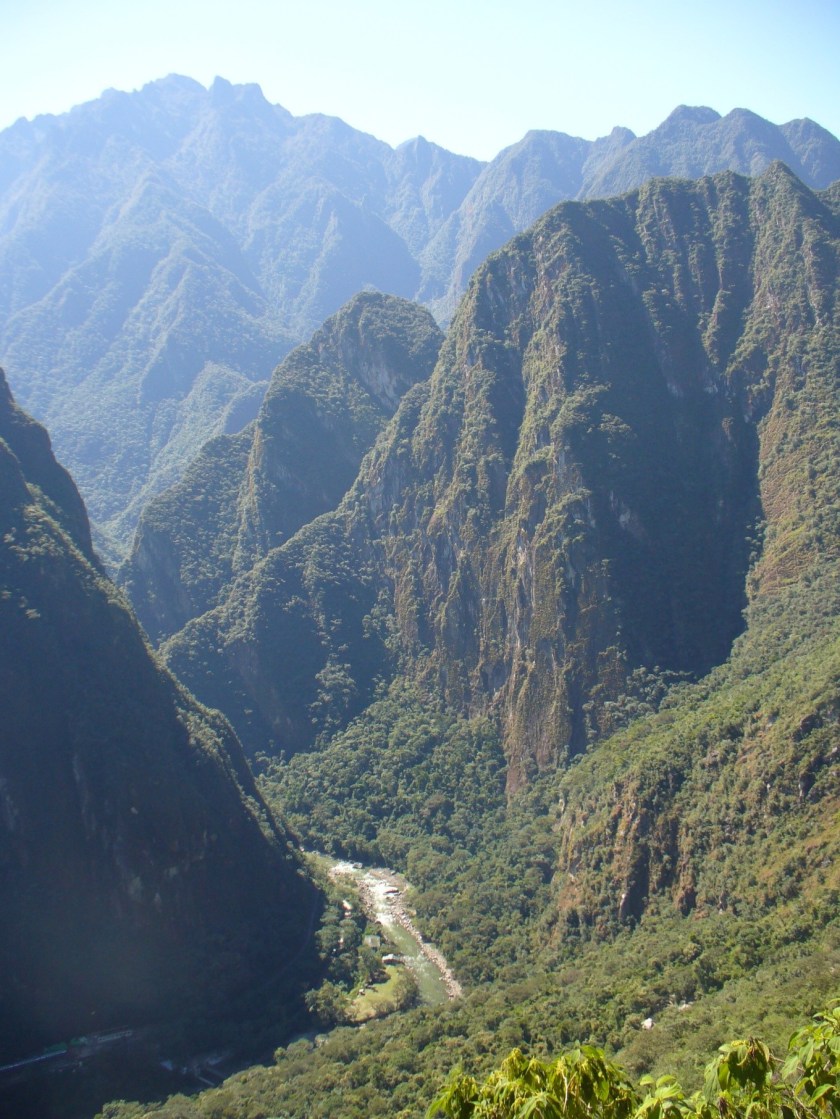
I end my experience with a pair of photographs that for me symbolized the beauty of the remote wild glory of Machu Picchu – the legendary lost city of the Incas.
 TBLOG
TBLOG 