Mission Trip to Lurin, Peru – June 2014
I recently completed another of my little adventures – a trip to Peru. This particular journey was unlike anything I have done before. My trip was in two parts; the first week would be sent in Lurin a suburb of Lima, doing missionary work with my church – Lord of Life Lutheran. We have a long-standing relationship with another Lutheran church there, Filadelfia Church and we would be working there. Following the week there, five of us would take a separate trip to Cuzco and on to the fabled ruins at Machu Picchu. The two elements or my journey were very different.
There were seventeen of us on the mission trip from our church. We left together from George Bush International Airport on the afternoon of Thursday, 11 June. The entire process from checking in to departure ran smoothly. The flight was on a nice comfortable 767, the first one I have ever flown on. I was impressed with the entertainment system and individual seat monitors that allowed me to watch a watch a wide variety of movies. I watched The Grand Budapest Hotel, a movie I had wanted to see but somehow missed, and The Lego Movie (again) just to see if it was as much fun as it was the first time I saw it. It was. What can I say; I am a sucker for animated movies.
We arrived at Lima International Airport just after midnight. Entry was just as smooth as our departure had been and soon we were trundling out to a waiting bus which then took us on a very long ride out to the Lurin District. Lima is a sprawling city of about eight million; nobody is quite sure how many people live in the metropolitan complex as there are many squatters who are neither counted nor count for much. Think of Lima as a poor, rather dreary LA only without freeways. That’s right, automobile transportation is all via surface streets. That made our trip from the airport to Lurin long and slow. Fortunately it was late so we were spared the worst of the traffic. This was a two-fold blessing as not only did we make better time, we were spared the trauma of watching Peruvian drivers. They drive in the confident expectation that holes in traffic will remain open or other drivers will make way for them. They also view traffic control signals such as stop signs and red lights as advisory in nature. This results in an accident rate per 100k vehicles of over 146. (The U.S. rate is 13.6).
Blissfully spared the daily drama that is Lima traffic, our bus carried us on through the cool night, with the Pacific Ocean on our right hand until at last we turned uphill toward Lurin and our hotel the El Mirador. The name translates to ’the viewpoint’ which makes sense as it is atop a fairly steep hill. Unfortunately, all you can see from it are dreary block houses and the thick gray clouds from the constant marine layer. The streets look like they should be dirt but are in fact paved. A strip of dirt typically does exist between the edge of the street and the sidewalk. Most of the buildings were of perforated brick supported by concrete pillars. It is characteristic of the local architecture to leave rebar sticking up from the pillars, which, with the generally shabby appearance of the structures, gives them the simultaneous impression of a construction project and a ruin.
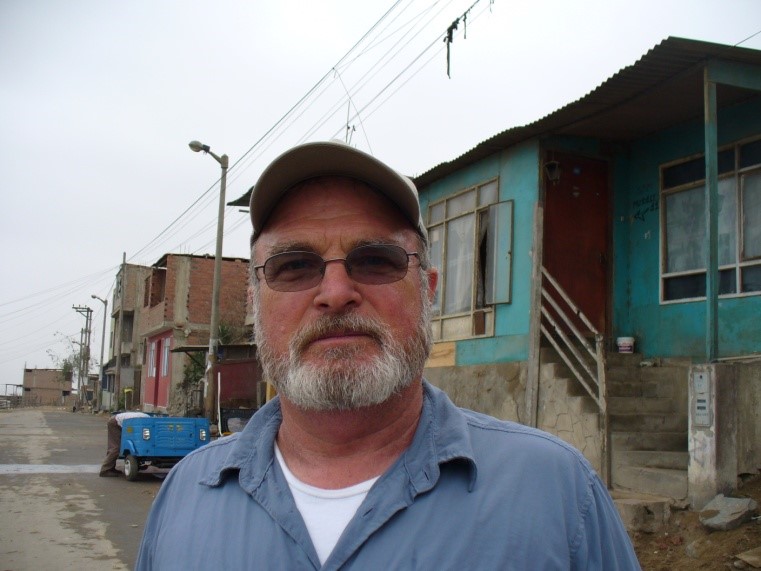
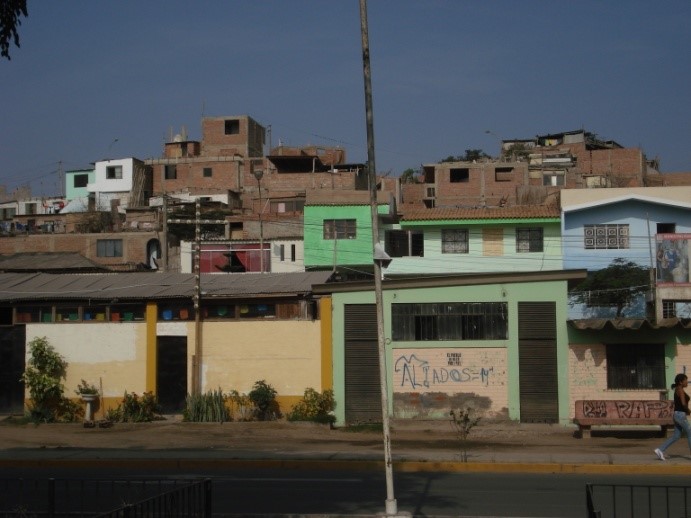
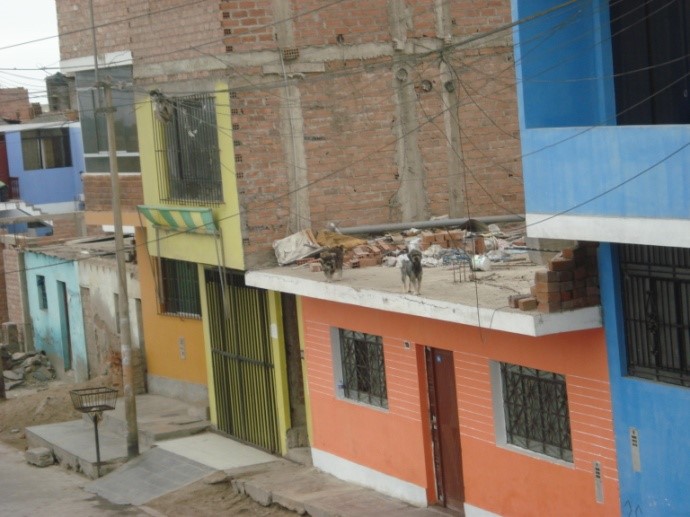
El Mirador, our residence for the next week, was a very basic structure; sturdy concrete walls, stairs, and ceilings with no heating or air conditioning (which were not needed), shower curtains, or beds longer than six feet, which meant my feet dangled off the end of the bed for the next week. My roomie Jamie was a true blessing; the man was positive, upbeat, and endlessly patient; I could not have had a better companion. We shared a room on the third floor which turned out to be a good thing since the hot water sometimes made it that high. The fourth floor never got hot water. At least the higher floors were somewhat less noisy; the ground floors let in more of the street noise. We think of street noise as mostly being traffic; there were not much of that around El Mirador, just a few cars and moto-taxis, the little motorcycle pedicabs so common in third world cities. No, the noise came from the pedestrians who stayed out in the streets laughing and talking until at least midnight. And the dogs. Like cities all over the developing world there were lots of dogs running loose. All kinds of dogs, from purebreds to mongrels, large to small, from sick and mangy mutts to some in apparently good condition. Instead of collars, people who claimed dogs often put little sweaters on them. The dogs were everywhere including on top of houses. They took their duties as watchdogs seriously. Once the pedestrians settled in for the night the dogs had the run of the streets with resultant barking. The barking lasted off and on until about four AM on most nights. That is when the poultry took over. There is no concept of zoning there, so many people raise chickens on their roofs – chickens and roosters. Apparently the roosters felt the need to tune up long before first light. All in all there was quite a cacophony all night long. The most charming noise was the periodic ringing that came from the garbage collectors. A man would precede a truck which was picking up garbage bags from the side of the street. His ringing would alert residents to bring out any trash bags for pickup.
One thing that is widely known is that it is NOT safe to drink the water. That includes ice, rinsing your mouth, or even glasses that are washed but not well-dried as well. Nor is it safe to eat items that might have been washed such as fruit or lettuce. ‘Peeled, packaged, or prepared’ are the watchwords. To prevent ourselves from getting dysentery we took all our meals at the church. We each had a bottle that we filled from boxed water there. We also used Oil of Thieves to boost our immune system. It must have worked – no one got seriously ill while we were in Peru.

This all sounds much worse than it was. We were so tired from the flight on the first night that most of us were able to get some sleep anyway. Of course, on the following night, a Friday, Lurin raised the noise level. There was a wedding two doors down. A tent was attached to the front of the house projecting well into the street and disco was alive and well. You may think you know Peruvian music, all calm flutes and such. That is true: for tourists in the country. City folk in Peru prefer ‘musica techno’ and they like it loud. Apparently the festivities lasted past two AM, but I do not know. I once did a deployment on an aircraft carrier. If I can sleep with airplanes literally landing directly over my head I can doze right through a Peruvian wedding reception. In fact, I was more troubled by the hard bed than the noise; I actually got enough sleep while I was there.
One of the classic elements of Peruvian indeed Latin American culture is the tendency to run late. Some people are charmed by the relaxed atmosphere, others driven to distraction by the apparent indolence and inefficiency. Either way it is something that must be accepted. One of the side effects is that Peruvians tend to start the day late and stay up late. This means breakfast (and that life-giving beverage, coffee) was not available until ten AM. Our church group would usually meet around nine, have a bible study, then walk the six blocks down to the Filedelfia Church were we took our meals. When I say ‘down’, I mean San Francisco-type downhill. On most of the days we were there we would work at the church or in the surrounding community. We took our meals together in one common room, boarding house style. Breakfast included bread, scrambled eggs, potatoes, and fruit drinks which we viewed with trepidation. Lunch and dinner were typical Peruvian meals of potatoes, rice and chicken or sometimes pork. This is what the Peruvian middle class eat and we were glad to share what they ate every day. After all, it was a mission trip, not a culinary adventure.
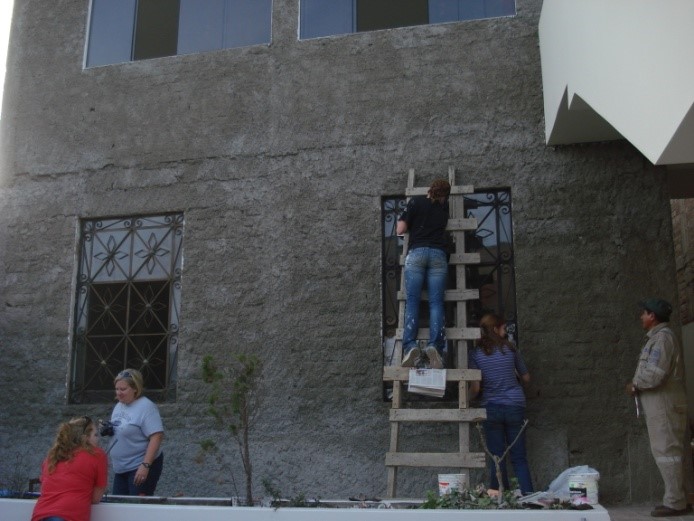
Our group did some painting and light maintenance on the church and in the community. It hardly ever rains in Lima so roofs tend to be rather sketchy things, often just corrugated plastic sheets, sometimes with gaping holes in them. Roof repairs sometimes consisted of just laying a corrugated sheet over an existing disintegrating one. Of course, this was mostly the case for outbuildings and the sleeping quarters (I cannot call them bedrooms) of the poorer folk. One interesting aspect of work in Peru is the freedom from all those annoying safety concerns that dog us in the US. Ladders were handmade and heavy, though not always stressed for the weight of an American male as Big George found out to his excitement. Fortunately he was quick enough to avoid a nasty fall when the rung on his ladder snapped. Step ladders consist of two homemade ladders with a hinge at the top and a couple of pieces of wire to prevent it from opening too far. Obviously you do not have any safety notices anywhere around any equipment. You are expected to be careful without having the government tell you to do so.
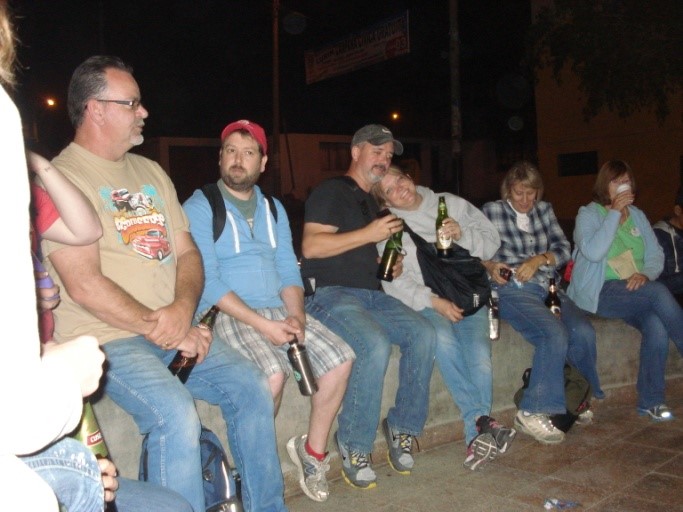
Since we ate so late, usually we were not finished until after Eight PM, we did not really have a problem with entertaining ourselves. We would walk up the steep hill and perhaps share a beer from the little stores (called bodegas) near the hotel. One and a half liters of Christal beer could be had for five Sols, about two bucks. Some nights we would sit on the wall outside the store and chat in the cool humid evening. This was a sense of timelessness in Lurin. The heavy marine layer prevented sunlight by day or stars by night. Further, there was a deep sense that this is the way things are and this is the way things will be. It is not true, but it feels like that. There is none of the energy or feeling from the people of how they might improve themselves. People are just trying to get through each day.
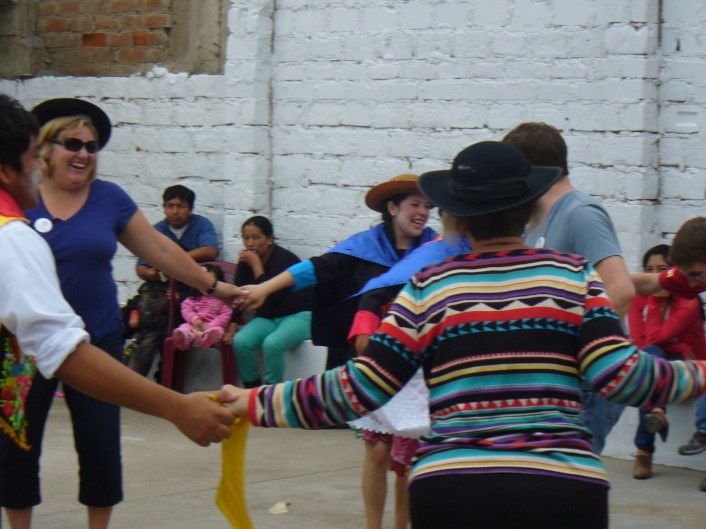
Sunday was an exception to this routine; it was Father’s Day, just like in the U.S. Except it is bigger deal in Peru. We all enjoyed a lovely 1030 service at Filedelfia Church (which actually began around 1115) followed by an event called a ‘tombola’. This is apparently a sort of a lottery which is used by the church to raise money for their ongoing daycare/preschool program supported by the church. The items you could ‘win’ for your one sol donation included a can of beans, a jar of baby food, a soap dish, and other things of that nature that had been donated. I returned the baby food and can I ‘won’ to be‘re-auctioned’ off. The church courtyard was lined with people sitting on benches and chatting, waiting for the dancers to begin. They started off with some simple demonstration dances with one couple at a time. Some of the dances were done in more or less formal attire. Later on that gave way to colorful outfits which included balloons covering the hats. As time went by the dances grew larger to include a dozen or so participants finally including even members of the mission team.

In the evening, we played games with some of the kids and did crafts. Debbie Eaton had made 85 little stuffed toys and these were handed out to the little ones to great excitement. Finally the children were given another treat: leche and pan – cups of milk and rolls. None of the children looked malnourished but all of them seemed glad for the food. The things we did weren’t really all that much, but it somehow it turned into a big day for everyone.
On the last full day in Peru we took a bus tour of Lima, first swinging by some long-abandoned ruins along the coast. The Incas had an amazing civilization, stretching from Columbia to Chile with at least 15 million people under their control. The Spanish tended to destroy the Incan buildings down to their stone foundations. We walked through some enormous remains, poorly reconstructed, that brought to mind the terms ‘wasteland’ or ‘lunar landscape.’ The coastal region of Peru is a desert; although it is humid and there are clouds and mists, rain is very rare. All crops must be irrigated – even in the time of the Incas. Huge piles of sand are slowly revealing lost palaces and fortresses. The government is trying to restore some of these lost structures in the name of archeology which also means tourist dollars to the nation. They have a long way to go.
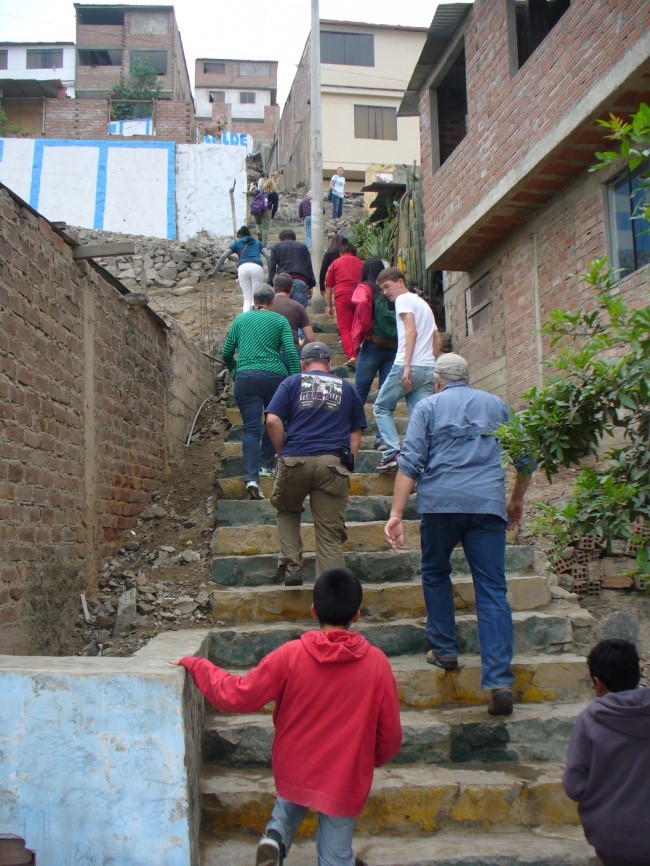
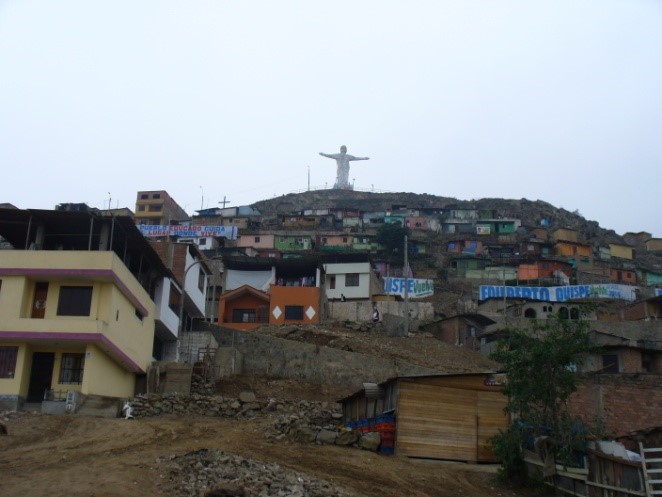
We next went up to a statue of Jesus located on one of the higher hills in Lima. Contrary to the tendency in the US, in Lima the higher you go the poorer the neighborhood. The city was established next to the port and services are slow to climb up into the hills. Since the statue was up very high above the city it was a pretty sketchy neighborhood; the roads were not even paved, and electrical power was a very ad hoc arrangement. There was no road up to the statue, we had to climb 409 very rough steps past shacks and abandoned houses to the top. Lima is not a pretty city. Most of it looks a lot like Lurin which is to say a massive urban sprawl.
The center of Lima definitely shows its Spanish colonial roots. The architecture reminded me of Manila or Puerto Rico. There are no real sky scrapers, only old well-built structures in the styles of the eighteenth or nineteenth centuries. We brought along some of the older children from Lurin. They had never been so far from their homes before and were thrilled to see the sights. We walked around the central plaza, saw the Presidential palace, government buildings, and visited one of the main cathedrals. Then we had lunch in a downtown restaurant, quite a treat, before being released at one of the main markets. We returned after a harrowing commute through Lima traffic to enjoy a barbecue at a home in Lurin.
Our hosts, members of the Filedelfia congregation, lived in a place that looked little different from the other houses on the street. Inside, however, there was a large courtyard with four commercial trucks. (Our host owned a trucking business that ran all through the Andes.) It was not what you might expect; a large part of the courtyard also held spare parts (or perhaps simple junk) and their home, though far from small, was made of poured concrete. The compound was filled with people and warm hospitality. Our hosts provided good food, ample drink, music, and there was even dancing. We had asked they give us a chance to sample a famous Peruvian dish, cuey or as we call it Guinea Pig. Tasted like rabbit or maybe squirrel. We had a wonderful time and partied (relatively) late into the night.
The following evening was the scheduled departure for twelve of our party. Five of us would be going on to visit Machu Picchu on our own. Our group split up to enjoy some final sights. I joined those who were going to go visit the Pacific Ocean. The beach reminded me of the California coast which is understandable – same chilly Pacific Ocean. Despite the fact that it was winter the water was not as cool as the water off San Diego. Also different, the beach pavilions and little shops and bars were closed for the winter season. Oh, and there was a dead seal rotting on the beach. You don’t see that much on California beaches.
That evening the big bus arrived to take the twelve back to the airport. We helped load their luggage in the bus and waved goodbye to them. The remaining five of us went to bed early. We had a scheduled 0300 bus of our own that would be taking us to another adventure – the famous Incan ruins at Machu Picchu.
 TBLOG
TBLOG 