Natchez Mississippi Book Signing 2009
I was fortunate that my cousin, Dr. William Pinney, and his wife Van taught in the MBA program at Alcorn State. This program was located at Natchez, Mississippi. They arranged for me to do a book signing of my latest book in a cool little bookstore there which provided my wife Ruth and I had a chance to visit Natchez. We piled into Ruth’s Mercedes and headed east from our home in Texas to enjoy an excursion to one of the unique, and uniquely lovely, towns in the south.
The word that best describes Natchez Mississippi is ‘bijou’. It is a proper little jewel of a city perching gracefully on a bluff overlooking the Mississippi River. Natchez is an old town; first established by the French, it has been a rich trading center for centuries. Stand on the bluffs overlooking the river and you can see the original source of wealth of the town; rich low fields stretching away, land perfect for growing cotton.
History in Natchez is not gently sprinkled but ladled over everything with extravagant abandon. Natchez was important to the old Confederacy, but fortunately not too important. Lacking a railroad hub, and generally sympathetic to the north, it was one of the few antebellum areas not razed by the Union armies. Thus, there are no fewer than 71 antebellum structures still standing in the town. Most of these homes were ‘town houses’ for the wealthy planters who owned plantations outside of town. These graceful and imposing structures bring in tourists who are now a major source of income for Natchez. In addition to the relative antiquity of the town, Natchez also benefits from its layout. Its city center is a classic grid, a small simple well-preserved set of buildings; the very image of how small-town once America appeared. Through possession of the French, English, Spanish, and Americans, it has retained its calm presence. And so it remains to this day. In a very real sense, Natchez is a knot in time, existing as it always has, in its own special place.
We entered the town from the west, over the twin spans of the suitably classic cantilever Natchez-Vidalia Bridge. Although Natchez is a friendly and welcoming place, it is always better when you have friends and family to welcome and guide you. My cousin Bil, who teaches at a near-by university, met us and arranged for us to follow him to our Bed and Breakfast lodging for the night, The Elms.
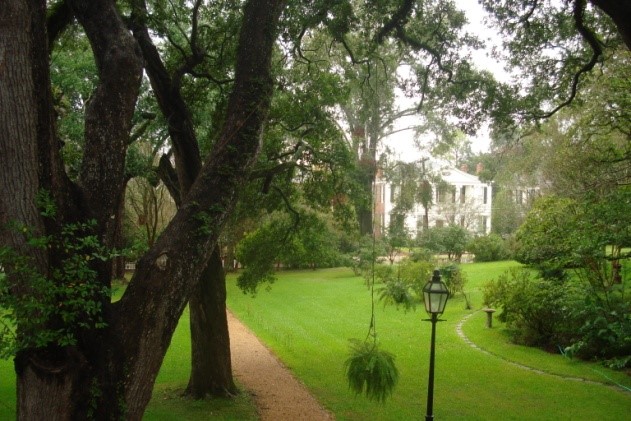
Built around 1804, The Elms is set in an old-fashioned garden surrounded by huge live oaks. The owner, Ester Carpenter greeted us graciously and showed us up to our room. Since it was a Thursday, we had the entire second floor to ourselves. Our rooms were furnished in lovely antique furniture including a heavy set of four hardwood bedposts surrounding a superbly comfortable bed.
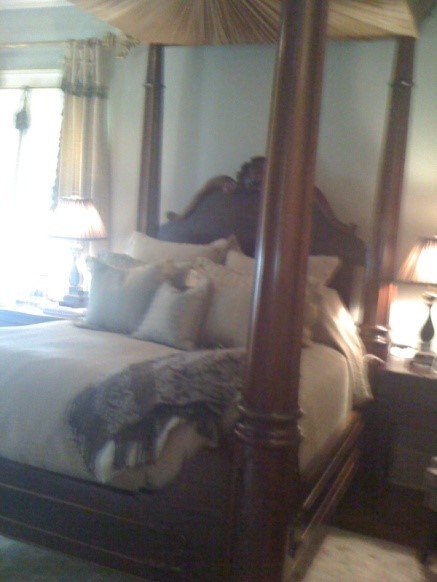
Like almost all the historical structures in Natchez, real care has been taken to maintain the grace of the finished structure.
Ester assured us we would not need a key for our rooms; they keep a sharp eye on the place and theft is very rare. It was time for a late lunch so we repaired to the Mighty Martini Bistro, an elegant place in the heart of Natchez that offered a wonderful dining experience. The weather was fine so we chose to eat outside, sampling and sharing our salads and pasta dishes on the patio.
There was time after lunch for a brief tour of downtown. The buildings are compact and elegant, with more than a few lovely churches and public buildings sprinkling the shops and restaurants. In many ways, it is a true old-fashioned downtown that has been replaced in so many other parts of the United States with soulless strip malls and franchised plastic eateries.
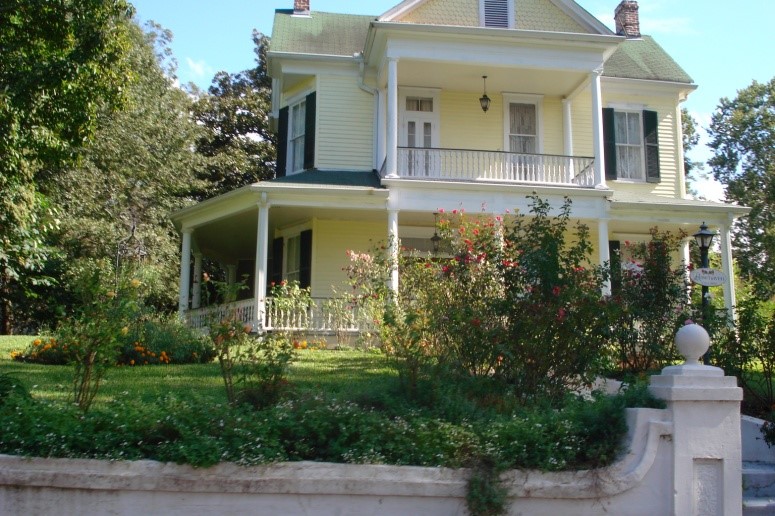
Our little tour ended with us returning to our rooms at The Elms so that we could dress up a little bit for our tour of one of the mansions.
Natchez shows off its fine selection of homes with two annual Pilgrimages where a select number of fine old homes are opened for tours. For a nominal fee, guests are received by ladies in period costumes who provide information about the homes and their elegant furnishings. Bil’s wife Van was ‘receiving’ at one of the homes that was open for this year’s Fall Pilgrimage.

We were greeted at the top of a lovely embracing curved entry staircase by Brenda, the lady of the house. Brenda was wearing a lovely green hoop skirt which matched her sparkling eyes. It seemed impossible that she was in fact, a grandmother. The very image of a beautiful, gracious southern belle, she welcomed us to her home and immediately made us feel as though we were old friends who had just returned from a long trip. Her home, called Rip-Rap, was initially built in the 1830’s. Inside the entryway, Van, attired in her own hoop skirt, explained the layout of the home. To either side of the entryway were two parlors, a lady’s room to the west where the light was better for sitting and doing needlework while chatting, and gentlemen’s room to the right, where the dark solid furnishings gave an invitation for sitting down and enjoying brandy and cigars. The furniture was a tasteful set of well-preserved Federal period antiques which included such features as low mirrors so that the ladies could easily check their petticoats. (Displays of proper Southern Belles’ ankles were discouraged.)
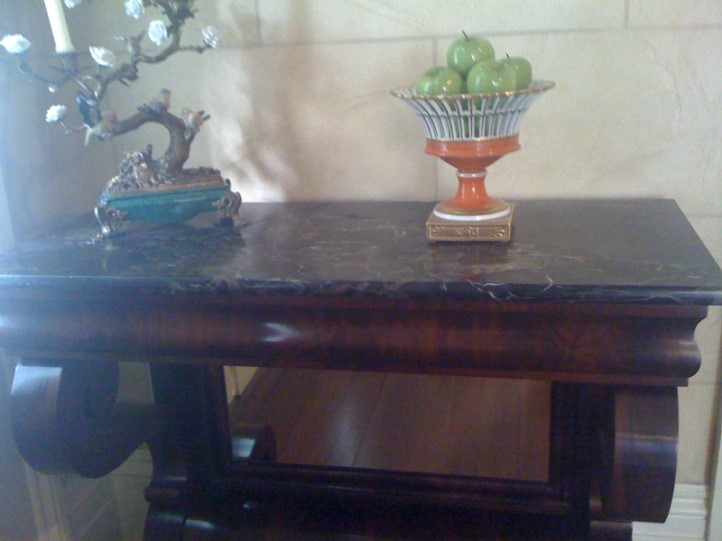
Like many other homes in the Natchez area, Rip-Rap began modestly, with additions made over many years until it reached its current elegant state. Originally the home consisted of two rather modest rooms, a single sleeping room and a ‘keeping room’ where the activities of the day were carried out. Restrooms were originally out of doors; the term ‘outhouse’ which once applied to any unattached building in a compound came to be used for the privies. Kitchens were separate from the main homes. Since all cooking was done over wood stoves, they tended to be hot places. Not only that, but they also tended to catch fire; far better to lose a small cooking shack than the main building. As time went by and the families prospered, rooms were added, (including modern kitchens and bathrooms) until the mansions in Natchez took on their current lovely condition.
Another characteristic of antebellum homes is the predominance of wide verandas, porches, and galleries. Until Mr. Carrier brought air conditioning to the South, people spent as much time as they could in the warm months outside in the cooler shade of the overhangs. This also accounts for the tendency for buildings to have upper stories to catch the cooling breezes. The large windows were another feature to promote (or improve) air flow. Since there was a tax on doors (!) many of these tall windows could be opened up and used as doors to the outside. Most of the buildings were cleverly designed to promote natural air flow through the home during the long hot summers.

Rip-Rap is Brenda’s third home and second stately home. It gives her and her husband a joint hobby to share, combining history, art, and a love of fine antiques. They live together in Rip-Rap year-round, opening it up for visitors during the Pilgrimages. Their ‘hobby’ extends to taking trips together looking for antique furnishings and art that will blend into their current beautifully coordinated home. That is the secret to the wonderful preservation of the homes in Natchez: hundreds of committed people who spend countless hours and large sums of their own money in private efforts to keep these structures in pristine condition. Large wooden houses require a tremendous amount of maintenance over and above such petty matters as keeping the home perfectly clean and turned out for guests. Some of these homes have been in the families for generations. Others were purchased by dedicated owners who undertook to maintain them as living works of art. Still others are purchased by groups such as garden clubs who undertake to maintain them as a joint venture. Some of these houses are used as private residences, such as Rip-Rap, or function as Bed and Breakfasts like The Elms. Some are open to paying guests year-round. Others have become restaurants. No matter what they are used for, the effect of so many fine, well maintained houses in one small area is lovely.
After bidding Brenda and her husband a regretful goodbye we took our evening meal in the Carriage House, the actual former carriage house of a famous local house, Dunleith, a fully colonnaded mansion set in 40 acres of sculpted gardens near the center of Natchez.
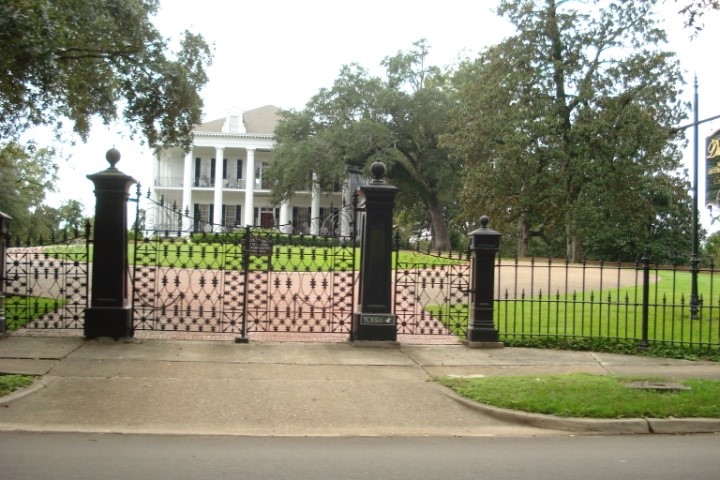
Following a delicious dinner, we were ready to retire back to The Elms for a night of uninterrupted slumber in that firm but yielding bed with its high thread-count sheets and thick soft coverlet.
It was not to be. Around 1 A.M. I was awakened by what sounded like someone rolling wooden hogsheads over a plank road; in fact, it was peal upon peal of distant thunder─ the first cool front of the year had arrived. After a quick peek outside I came back inside and woke Ruth up to share the experience. We sat in thick, soft robes on a glider beneath the twelve-foot-wide gallery watching a spectacular light show in the night sky. Over the next half hour we were treated to an almost continuous display of lightning and thunder in the near distance. The rain was steady but not especially hard. The wind blew enough to jangle the wind chimes in the oaks around the house and occasionally drift a light spray over our bare feet. The flashes revealed the garden below with the upper branches of the broad Live Oak trees that surround the house bowing and waving in response to the gust of the little storm. Live oaks are solid, dependable, people-friendly trees. Their muscular trunks and think branches provide shade and protection. They are big trees, not especially tall, but spreading out to shelter lots of ground below. We sat together on the gallery until the front had passed, bringing cool fresh breezes with it; then we slipped back into our room and into a sound, restful slumber.
The next morning, I was up with the dawn, drinking in the cool clean air. A light jog took me to the Mississippi, where mist and fog gave the river a hundred feet below me a mysterious and romantic aspect. You almost expected to see an old paddle wheel steamer come churning up the river.
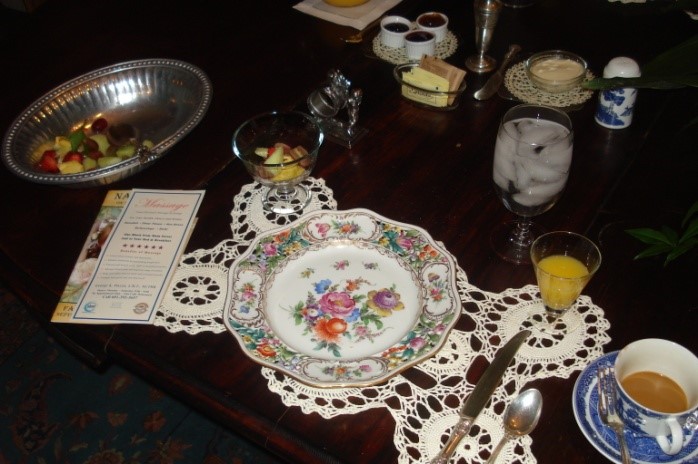
Breakfast is the best part of staying at a Bed and Breakfast. Ester has the reputation of being a fine cook and she lived up to her billing. The breakfast setting was elaborate: lace table cloth, china, silver, and crystal. The meal itself was simple─ fresh fruit, bacon, scrambled eggs, grits, and fresh biscuits. Of course, the grits were perfect. It is amazing how difficult it is for some people to properly cook grits; Ester knows how. We left The Elms with reluctance.
Bil and Van took us on a tour of three of the ‘don’t miss’ attractions in Natchez. First, we went to the Stratton Chapel Gallery in the First Presbyterian Church. The gallery offers many hundreds of expertly restored photographs of Natchez taken throughout the second half of the Nineteenth Century. They provide a fascinating glimpse of the people who lived in Natchez at that time. The photos show everything from studio portraits that give an entrancing view of the changes in women’s fashions, to the river where levies were constructed and steamboats chugged up and down the river. The suggested donation of $5.00 makes a trip to the gallery one of the great bargains for anyone interested in the people who once lived here. We were pulled away from the displays to visit what is perhaps the most unique of all the stately houses in Natchez: Longwood.
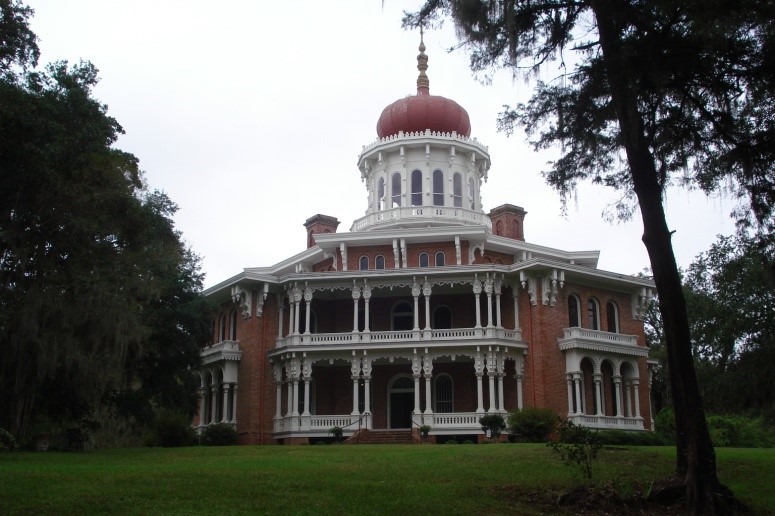

The designer, Haller Nutt, was a true polymath. He obviously had considerable talent as a designer. His planned home was an octagon, incorporating economy of design, intelligent use of space, and such innovative designs as a center core providing light and air. He even intended to use light pipes to illuminate the lower floors. I say intended because he had the enormously bad fortune to start work on his dream house in 1859 using workers from the North. The structure was still under construction before the War Between the States intruded. The exterior and lowest floor were completed and are still maintained by the Pilgrimage Garden Club. It is amazing and heartbreaking at the same time to go from the lower level up to see the permanently unfinished upper levels.
Our visits to those venues took all morning and gave us a healthy appetite. Pearl Street Pasta solved that problem magnificently. I was not aware that Natchez had so many fine, charming places to eat; each is unique, I did not see a franchised place anywhere in town.
There was no time wasted after our delicious meal; it was off to the Natchez City Cemetery. I am not normally a big fan of graveyards, but Natchez does not have your normal cemetery. It is not only beautiful, it is entrancing. The setting is lovely ─ located on a hill, it encompasses lovely rolling terrain, lush lawns, occasional trees and many varied monuments. The people of that time believed in erecting suitable monuments to their beloved dead and many of the sculptures are achingly beautiful. Numerous beautiful, creatively designed iron fences, benches, iron mausoleum doors, tombstones and monuments are scattered throughout the cemetery. The varied patterns of ironwork alone are worth the visit.
The famous Turning Angel is a prime example of the monuments. She was placed over the graves of eight young girls killed in a gas explosion at their workplace, a truly tragic story.


That is the other fascinating part of the cemetery ─ there are hundreds of colorful, tragic and touching tales. There is the story of Louise, young woman, who through a series of misfortunes, ended her life as a prostitute. As she lay dying, she declined to provide her last name to her preacher to avoid bringing shame to her family. She must have made many friends, however, because she was buried in the city cemetery with a fine headstone bearing her chosen epitaph: Louise The Unfortunate.

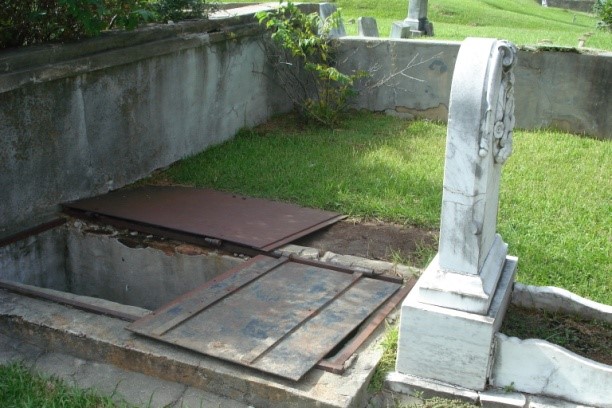
There was also the heart-breaking grave of Florence Ford. She was an only child, a sweet girl of 10 when she died of yellow fever. Upon her death, her mother was so struck with grief that she had Florence’s casket constructed with a glass window at the child’s head. The grave was dug to provide an area at the child’s head, the same depth of the coffin. This area had steps to allow the mother to descend to her daughter’s level so she could come to the grave to ‘comfort Florence’ during thunderstorms.
During Halloween, the people of Natchez raise money for the upkeep of the cemetery by putting on recreations of some of the famous or tragic people who are buried here. Volunteers in period costume wait by ‘their’ graves to tell their sad stories. It certainly beats trick or treat.
After our visit to the Natchez City Cemetery we crossed the road to the nearby National Cemetery which overlooks a bend in the Mississippi far below. The view is magnificent. The markers are less so: they are standard military issue, some with recent dates. It is a long way from the battlefields of Iraq and Afghanistan to a quiet cemetery above the Mississippi but some of our soldiers have made that somber journey.

We went straight from the National Cemetery to our second B & B, Linden. Jeannette welcomed us with the grace of her years and upbringing. Her children are the sixth generation to reside at Linden. The house dates back to 1790, but has been updated with many additions over the centuries. Linden is most famous for having its front door used as the model for Gone with the Wind’s mythical Tara. We hardly had time to settle in before it was time to leave for my book signing gig at Turning Pages, a charming local book store that is a bookstore. After the event had wrapped up, Ruth took me around the block to a place she had discovered while shopping during the book signing. Breaud’s was open late enough to accommodate us. We split a great big steak (pun intended) while chatting with our fellow diners. Then it was back to Linden for a good night’s sleep.
In the morning, we had another wonderful breakfast on china. We were fortunate enough to have Jeanette give us a tour of her ancestral (by marriage) home. Though not local, her training as a debutant in Oxford, Mississippi gave her all the poise needed to successfully fill her role as Mistress of the Manor for many decades. Though in her 80’s, her charm and wit are intact. In addition to showing the home and antique furniture she also filled us in on some of the people who lived in Linden over the generations. She also gave us a sense of what it was like to raise a family in such a home. One story was illustrative─ as a bride she was shocked to see her new husband walking along the inside gallery in his underwear. When she chastised him for this behavior he responded with an irrefutable argument. “Jeanette, my dear, my family has walked on this gallery in their underwear for 150 years!”
At the end of the tour, I had to ask her about Linden’s famous ghosts. She regaled us with a feast of stories of the spirits that were said to haunt the old manse, including her late father-in-law. All were said to be benign.
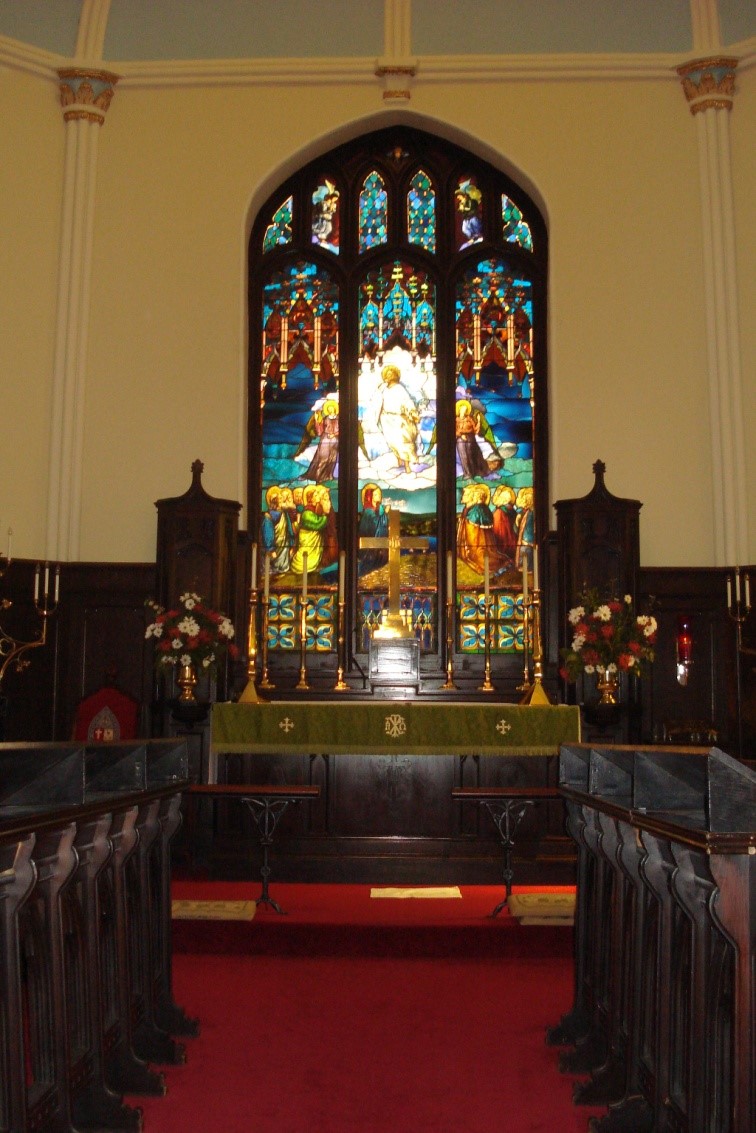
After our departure from Linden we took time to visit the beautiful interiors of some of the local churches. We visited Uptown Grocery for some pizza and sandwiches and took them to a picnic ground on the bluff where we could watch tow boats pushing barges up and down the river on one side, the town of Natchez on the other, and preparations for a garden wedding on the other. Then it was time to go home, a place that now seemed bland and uninteresting.
Natchez is a wonderful destination. The city has unexpectedly fine dining, superb architecture, and best of all friendly, interesting people. We will definitely be coming back.
 TBLOG
TBLOG 