Houseboat vacation on the St. John’s River – May 2009
My wife, Ruth and I wanted to have a nice, relaxing vacation, with little to do except eat, sleep, and take it easy, and I had a plan to meet those requirements. The plan was simple. Ruth and I rented a 45-foot-long houseboat which was berthed in the lower St. John’s River about a hundred and twenty miles south of my boyhood home of Jacksonville, Florida. We would drive from Texas to Florida, staying with friends and relations. The night before we were due to pick up the boat we would stay with my sister Dianne and her husband, Lamar. We would go down first thing on Saturday, move into our floating resort, and take Dianne and Lamar for a brief jaunt before setting off alone together for a week of idle relaxation on the quiet river. We drove across from Texas to Florida, staying at the Navy Lodge in Pensacola. Our little room was nice but nothing special… except that it was right on a perfect white beach looking out over Pensacola Bay and the Gulf of Mexico just beyond. We walked on that beach watching a lovely sunset to the west.
The next morning, Friday, we coasted in to Jacksonville, staying with my sister Dianne and her husband Lamar that evening. We enjoyed a pleasant meal and prepared to begin our adventure. The plan was for Dianne and Lamar to join us later in the day after we had gotten the boat sorted out.
Dianne & Lamar decided to sleep in Saturday. We were breakfasted, packed and ready to go long before they were up. We left a note and then left ourselves. We arrived after a pleasant two-hour trip with only a few problems in finding the location of Holly Bluff Marina where our houseboat awaited us. We, being early, were allowed the pick of the boats. The first, Endeavor, smelled of cigarette smoke – not acceptable. Our second choice was Egret. She was satisfactory in all respects. We used the blue carts provided by the marina to quickly load our belongings aboard her. Then we were off to the grocery store for provisions. Just as we entered the Winn Dixie, a thunderstorm broke over the area. We shopped like sailors, sparing few expenses; when we emerged from the grocery store over $200 poorer the rain had slackened.
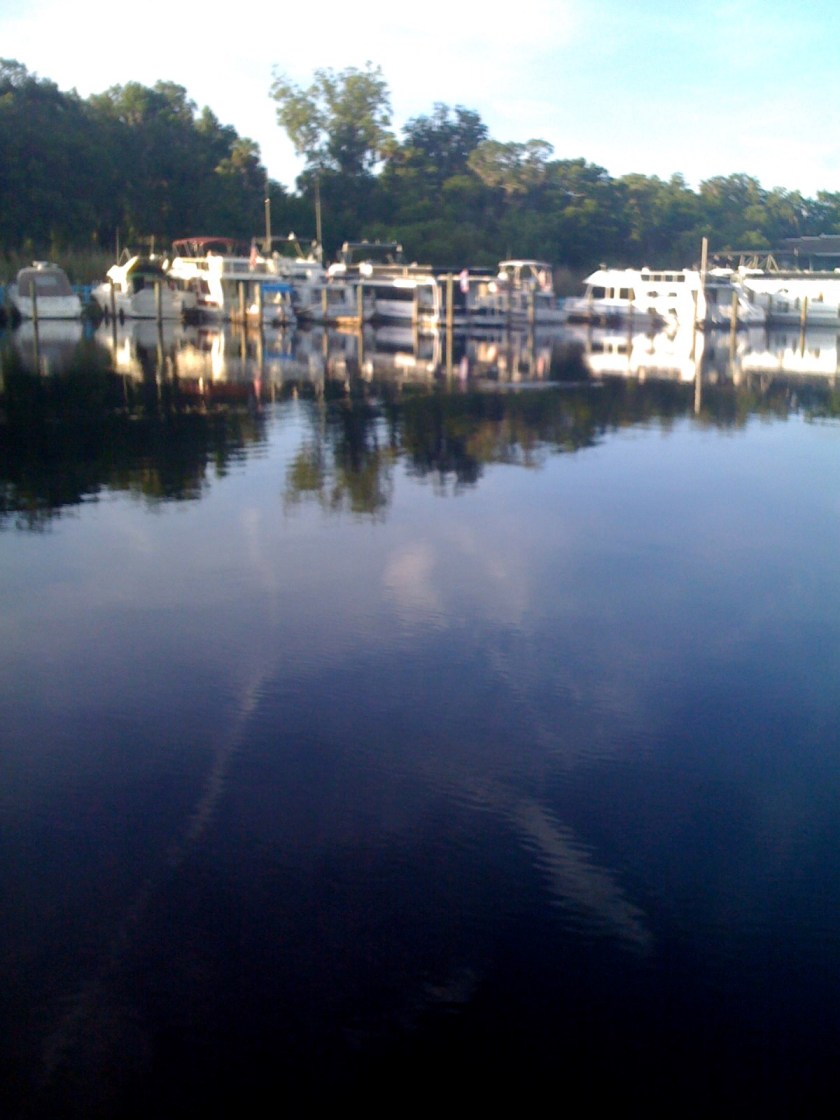
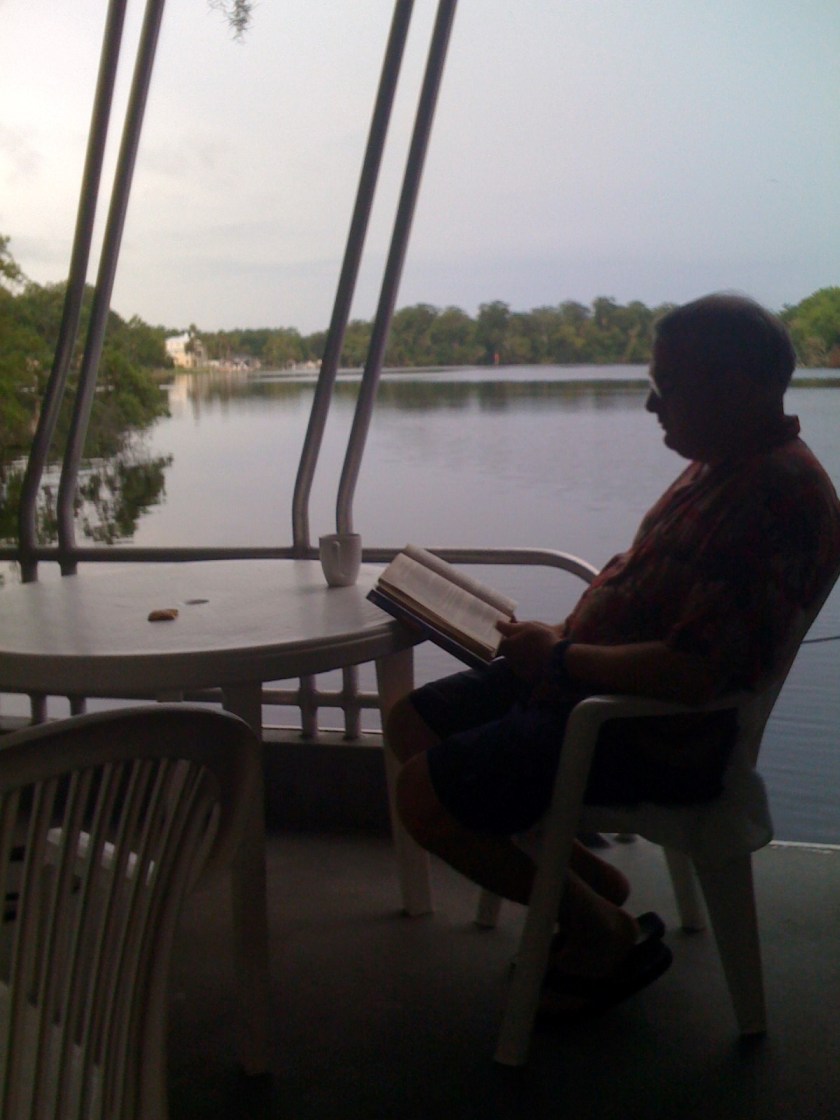
Back at the boat we had time to stow our vittles and get our briefing on the boat before Dianne and Lamar arrived. Once our passengers were embarked the marina rep gave me a five minute houseboat handling demonstration and then allowed me to bring us alongside the fueling pier.
“Do you think you can handle her, Captain?” he asked.
I am a retired naval officer. What was I to say but ‘yes’? With a smile, he cast us off into the stream. It did not take long to confirm that Egret was a cranky, difficult beast to master. These big houseboats are all top hamper and no keel, which means that in any sort of breeze, the wind will push her around like a schoolyard bully. These boats have an inboard outboard stern-drive. The stern units require at least four full turns of the wheel to go from lock to lock and the turning response is dreadfully slow. This is in marked contrast to the throttles which are very sensitive; making only minor changes in power settings was very difficult. The boat went from too slow to ‘Varoom!’ in a quarter inch of movement of the throttle lever. Finally, because the helmsman’s control station is so far forward of the boats pivot point, it is difficult to determine when course changes have taken effect. This means you spend a lot of time correcting and then over-correcting your course. You tend to yaw back and forth down the river like a drunken sailor on ice— all very embarrassing.
At least the Egret’s accommodations were comfortable and well laid out. There was a large covered foredeck or ‘front porch’ with gas grill and plastic table and chairs. The ‘front porch’ turned out to be a very pleasant place to sit and read, being cool and breezy. Past a sliding glass door was the main cabin. The helmsman station was located to starboard. Against the port side bulkhead was a very comfortable sofa that allegedly opened out into a bed. It does very nicely for naps as it is. Immediately aft of the sofa is a round glass-topped dining table with four padded chairs. Along the starboard side, just aft of the wheel is the galley, complete with a four-burner stove top, a microwave/convection oven, sink, counter-top, and refrigerator. Directly aft of the galley, still on the starboard side, is the head. The facilities are large, comfortable and airy, even including a walk-in shower. Of course, the main purpose of a head is the dreaded marine toilet. Ours was actually quite easy to use, once you find the button to flush it which was cleverly disguised as a knob on sink cabinet. The two sleeping staterooms were on the port side, the first one slightly raised and the second, farther aft, located two steps down. On the stern was a smaller uncovered deck that houses an enormous air conditioning evaporator and a ladder to the area on top of the deck house or ‘roof’. The railed-off roof was a great place for sunbathing. All in all, it was better than many apartments I have lived in.
Our first day was fine- sunny, with scattered high clouds, the summer temperatures mitigated by a pleasant breeze. The river immediately bent to the east, passing between a marina on the east bank and Hontoon State Park on the right. We intended to moor at the Hontoon Marina that night but I wanted to show Dianne and Lamar a bit of the river first so we cruised on by; after all, it was only about 2 in the afternoon. The river quickly opened out into a fine open area. Lamar and I, taking turns at the wheel, continued along placidly. Between the pleasant weather and lovely scenery, we were all having a great old time until the river ran out. How could that be? A quick check on my handy iPhone’s GPS map revealed we had completely missed the St. John’s River channel and had entered Lake Beresford. This was not a big deal, as there was adequate water beneath the keel, and the vistas along the bank were charming; even so, it was not what we had intended to do. We motored back up north and after a brief search, found the St. John’s River again.
The St. John’s River at this point is wild and beautiful. The river is typically 100-200 meters wide with subtropical jungle rising steeply on either side. There are occasional houses along the river, most with well-maintained docks jutting out a few yards into the river. Mostly, however, it is completely devoid of any evidence of humans. On weekdays, there is little river traffic, only occasional fishermen, typically anchored near the shore. That shore is obviously floodplain; flat, wet, and heavily overgrown. It almost begs for some dinosaur to come blundering through the heavy underbrush coming to drink in the steadily flowing river. The trees are generally water tolerant cypresses, oaks, pecans, willows, pines, and a variety of species unknown to me. Many are festooned with Spanish moss. Often the oaks are almost covered with moss and ferns that seem to find their rough bark a good home. The river is very quiet. The most common noise to intrude is that of distant aircraft, usually going north/south between Miami and the great northern metropolises. The water is dark and often deep, depths of over 30 feet are not unusual according to our fathometer. The current is not obvious, but it is constant, a steady, pressure, easy to overlook but subtly powerful.
Our trip continued upriver two miles to Blue Springs, a popular local site. Two miles may not sound like much but once all the bends of the river and Egret’s wallowing from side to side in the channel are taken into account it took about 45 minutes. Also, I demonstrated my remarkable ability to get lost, even in a river. There was this side lake and I took a lovely little side excursion up into it. No worries, we were out for an afternoon cruise, the destination was only an excuse for our journey. After a nice picnic lunch on the river we headed back to our original departure point so Dianne and Lamar could recover their car and go back home. Our landing back at Holly Bluff Marina was uneventful; we disembarked Dianne and Lamar and set out again on our own. Our landing at nearby Hontoon Island was not exactly smooth. The fuel piers at Holly Bluff were set up into the prevailing wind and current, making landing very simple. The two piers at Hontoon Island were at right angles to the wind and were much shorter. Adding to the difficulty, as we approached the pier, Ruth saw a set of orange “reserved” cones on our chosen landing site, requiring a sudden change in mooring plans. The result was not pretty, resulting in a missed landing before any contact with the pier was made. We backed up and came in again, safely landing without damage to anything except some feelings. Adding to the discomfort we discovered that the only available pier supported 30 amp power, not the 50 amp we needed. That meant that in order to have power for cooking, refrigeration, and most critically, air conditioning we would have to run our generator. The generator was a wonderful piece of work- it was reliable, starting easily every time and running like relatively quiet clockwork. Of course, it burned about a gallon of $3.65 per gallon marine gas an hour. Run it all day and you have spent the price of a motel room. Ruth made a wonderful shrimp salad for us and we retired early. There is little to do after sunset on the river except read and listen to music; as I mentioned it is very dark and quiet. Fortunately, the Egret’s beds were most comfortable.
The facilities on Hontoon are very primitive as the only way onto the island is by boat. Most campers use the little electric ferry run by the park. We took a nice stroll through the island. The walk was good exercise and gave us insight into the surrounding countryside. We saw a wide variety of local flora and fauna including deer and wild turkeys. After a nice breakfast aboard the Egret, we were off to the north, heading down river. The St. John’s River is very unusual in that, like the Nile, it flows north for its entire length. We saw many wonderful nature sights almost at once. There were many ospreys out making their living by fishing along the river. Within an hour of setting out we had seen a wide variety of birds including, spectacularly, bald eagles out looking to mug some hardworking osprey of his freshly caught fish. Four vultures sat in a macabre perch on the bloated carcass of an eight-foot alligator.

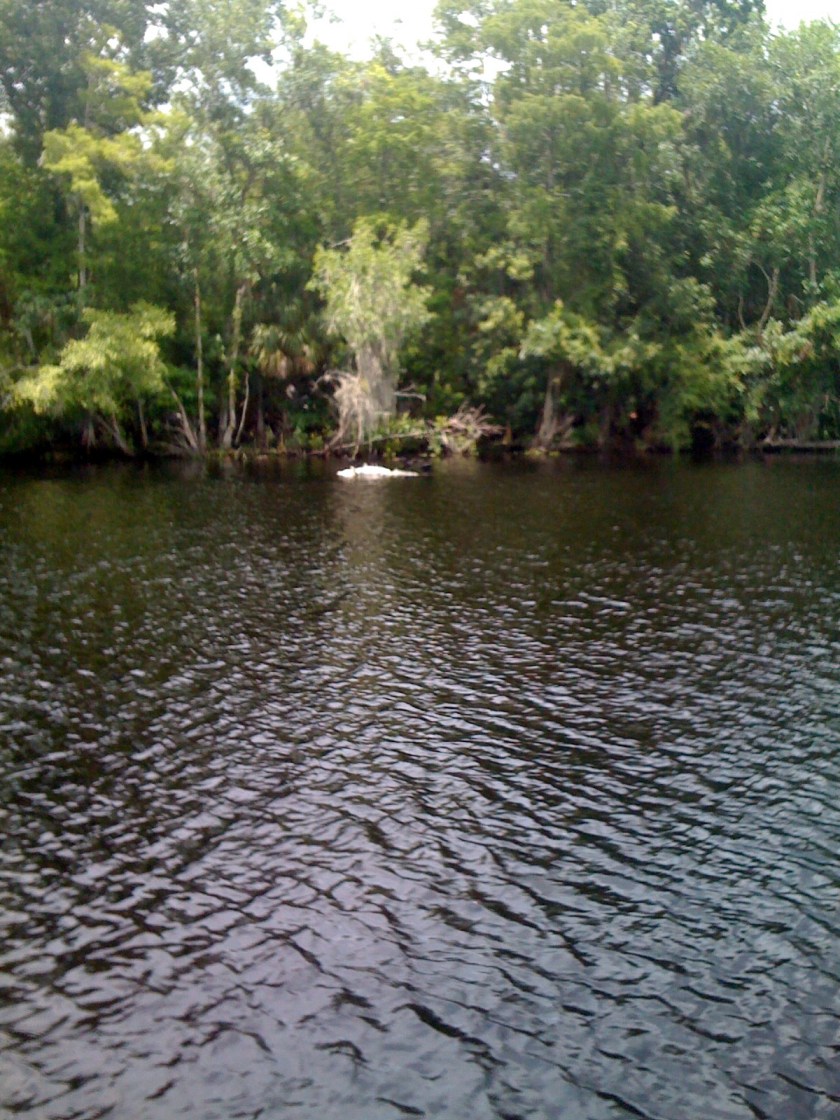
An hour downriver we passed under an old-fashioned drawbridge; listening to the sound of the bridge going up brought back memories from my youth when the raising of the old Ortega River drawbridge was the background sound of my childhood. Soon we left the scattered houses along the riverbank behind and motored quietly north between walls of silent vegetation. We did not plan on going all that far on our first day north. Soon, we arrived at the site we chose from the recommended anchorages, an island called Devil’s Elbow. The island was a typical oxbow, a bend in the river that had been cut off, leaving a characteristic “D” shaped island. This was the very definition of a backwater. We nosed in carefully checking to make sure there was the requisite three feet of water that Egret required. After some exploration, we settled on a nice secure spot, and anchored in solitude, setting our anchors fore and aft in river bottom mud using a pair of 22 pound Danforth anchors with generous scope of anchor rode.
A maritime note here- I was not just a naval officer, I was a Surface Line Officer with service in destroyers and frigates. Before driving the Navy’s big ships, I was an avid sailor. So, I take boats and boating very seriously. That means I know what can go wrong, and on the water, there is a lot that can go wrong. I try to prepare for contingencies such as dragging anchors, shifts in the wind, and stuck or non-working throttles. There is no truth to the reports that I required a 15 minute briefing before every mooring event. I will admit to using some esoteric nautical commands such as ‘ease her to starboard’ and suchlike. This became an issue because most anchoring required one person to drive the boat and one to do the heavy lifting and such. Ruth had only limited experience in maneuvering boats, but it did not take long to realize that it was much easier for her to learn to control a houseboat than for her to learn how to be strong enough to lift heavy anchors with a fathom of chain attached. I would initially attempt to provide accurate, nautically correct instructions to Ruth to which she would reply, ‘do you want me to turn the wheel clockwise or counter clockwise?’ Eventually we sorted out a system which worked well. Compared to others driving rented houseboats, we came to be considered skilled in maneuvering our clumsy craft.
Unfortunately, I soon found that thick black mud might be easy to set an anchor into but doesn’t hold. Every hour or two I would find out that we had drifted a dozen feet down wind. Not a problem except that if you plan on spending the night, a few yards an hour can lead to a disaster overnight. After some trial and error we did find a place where we could stay more or less without slipping slowly into trouble. We saw our first (of many) alligators. In fact, a six-footer come around and actually made a complete circle around our boat. Eventually I overcame my aversion to going aground and would push Egret’s big bluff bow into the bank and make fast to a tree. She did not seem to mind at all.
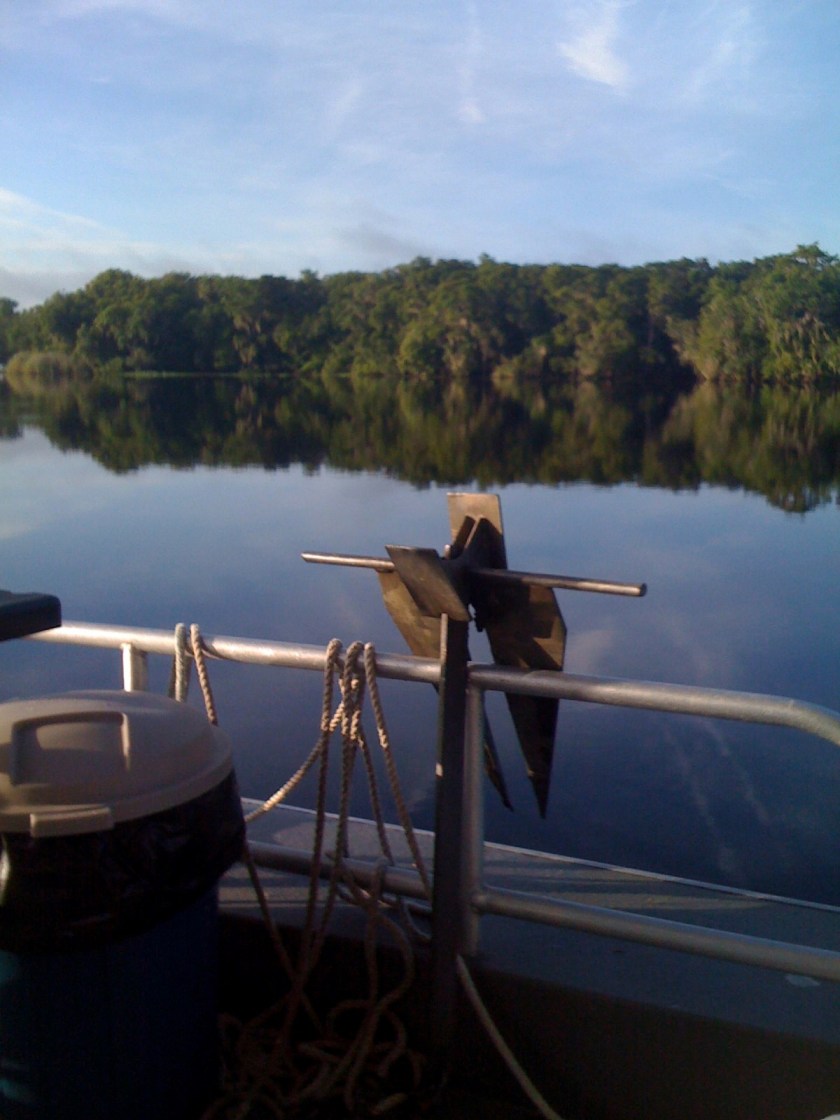
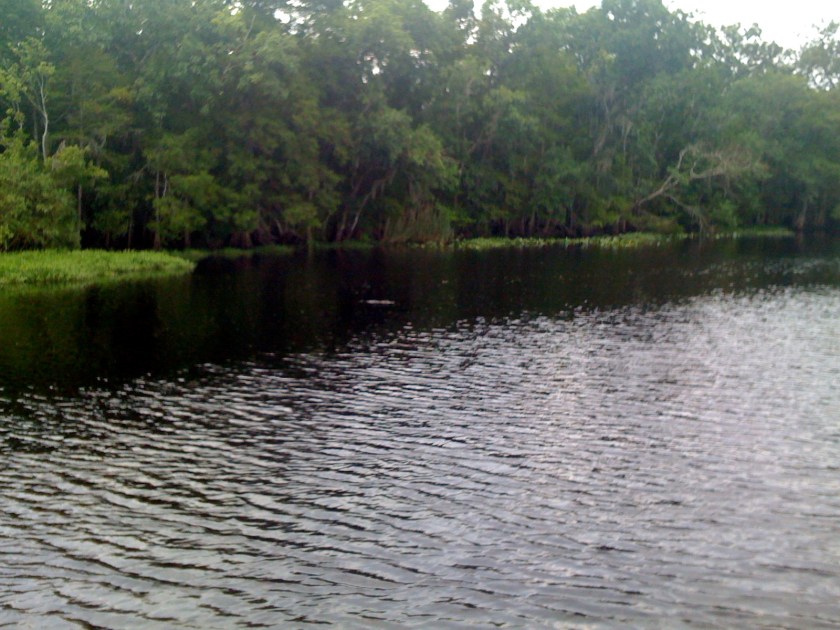
We were so isolated that it was possible for Ruth to tan areas she did not normally expose to the sun. Our time was spent napping, reading, and watching the river and its wildlife. When the sun went down, so did we for a long summer’s nap.
The next morning was a continuation of more loafing about in splendid isolation. It was so peaceful we were considering just staying there for the rest of the day when a better opportunity suddenly presented itself. Lamar, my brother-in-law, called to ask if he could meet us with his boat up at the town of Astor, about 10 miles farther north. Great! We finished lunch, upped anchor and headed downriver. Ten miles goes slowly at six knots, we slid past Lake Dexter where the charts warned of unmarked submerged pilings just outside of the channel and on up to Astor. I was so busy ensuring we could safely pass beneath the bridge there that I did not notice Lamar putting in his 18-foot runabout at a nearby boat ramp. By the time he was in the water and underway we were under the bridge and well past him. No worries, he quickly caught up to us and moored alongside and we proceeded down the river in tandem. A mile or so farther down was Morrison Island which has a fine protected anchorage. We put the nose of the Egret up against the bank and Lamar slipped a rope around a tree. Then we set an anchor aft and were secure for the rest of the day. Lamar and Ruth headed out in his speed boat for a high-speed cruise up to Silver Glenn, a popular spot several miles north on Lake George. I stayed onboard the Egret and prepared some smoked venison sausage with a curry pilaf. After their return, I got a short boat ride myself; the river looks a lot different at thirty knots than it does at six. After sharing a wonderful meal with us, Lamar zipped off for home and we settled in for a grueling evening of reading and napping. Rain began falling, with its usual soporific effect.
The next morning, Tuesday, brought clouds and cool rain showers. We headed back south at our typical leisurely pace. This turned out to be a good thing as we watched fierce lines of thunderstorms training along just a few miles in front of our path. Instead of the previous day’s hot sun we had a steady drizzle. This might sound dreary, but it was not; instead it gave us a snug feeling as we turned off the air conditioning and slowly edged out way back up river. We safely dodged the bad bits of weather and eventually settled, after a bit more ‘mooring drama’ into another backwater called Happy Hill. Once again, we settled into our routine of resting, napping, and reading. We had another terrific meal, spaghetti with mushrooms and shrimp. The evening ended with us sitting on the top deck watching a glorious sunset together.
Wednesday was a big day; we departed our secluded site at a reasonable hour and motored back up river to where we started, Holly Bluff Marina. At 2:30 we were joined by my cousin Martha along with Dianne and Lamar for our own little dinner cruise. We cruised up the river with our passengers, chatting, sipping wine, and enjoying their cruise. Near Blue Springs we cast out our anchor and enjoyed a sumptuous feast of grilled salmon, asparagus, and a rice curry pilaf. The weather cooperated as the rain the day before had kept temperatures low. After we returned to the marina we celebrated our successful dinner cruise with a bottle of champagne. After our guests left, things became briefly interesting. Several other boats returned to the marina with a variety of needs such as fresh water, and requiring assistance in mooring, culminating with the arrival of some drunken Russians whose boat was having engine problems. Since the marina staff had departed at 5, we had to pitch in and lend a hand. We were up until almost 10 PM.
Thursday morning, we were out early and headed back to Blue Springs again. It is a popular place, so spots to run ashore on the little narrow beach near the state park are at a premium. Of course, if you arrive at 9:00 AM this is not such a problem. Blue Springs State Park is a nice, well-maintained little place. It has been inhabited for centuries, and settled by Europeans for a hundred and fifty. There is a nice old house from the early days and a variety of historical memorials. Mostly, however, Blue Springs is about manatees.
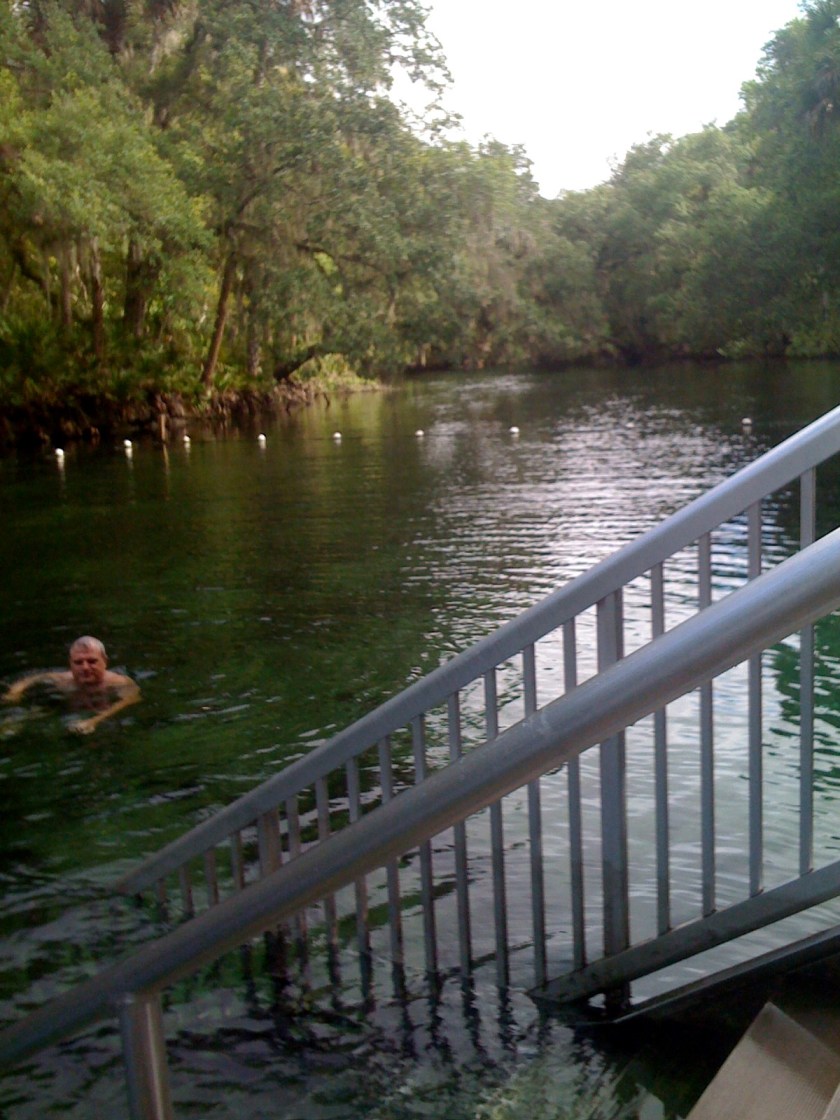
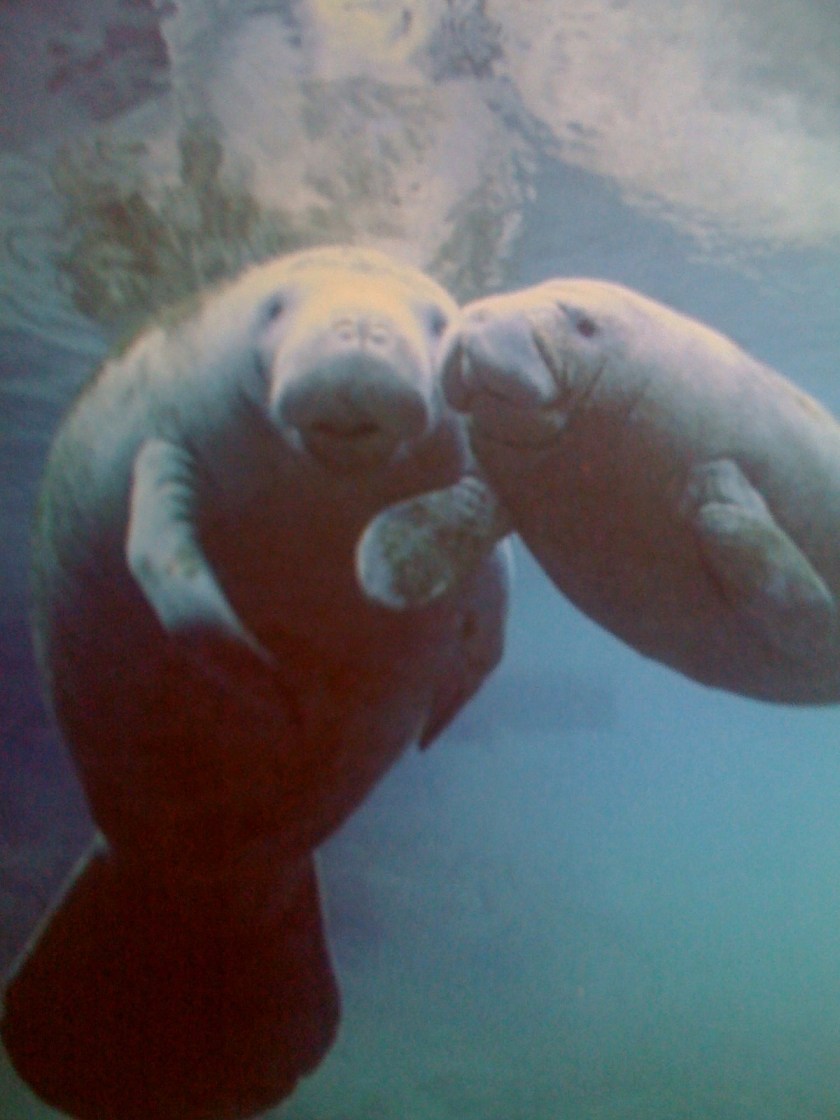
These huge gentle mammals have captured the imagination of many people, including Ruth. Because manatees need water that is warmer than 60 degrees, during the winter months they are attracted to Blue Springs which comes out of the ground at 72 degrees all year round. However, in the summer the big beasties are hard to find in this area. I did take advantage of the crystal clear water for a brief dip; chilly but astonishingly refreshing.
By lunchtime we had seen all we wanted (except for a manatee) and pulled off the beach to allow another boat to have our spot. We knew were we were going to spend the next 18 hours and it was not far away. The previous day we had scouted a set of trees on the backside of another secluded oxbow, only a half mile from the springs. We moored with ease and made fast, our bow against the bank. The biggest drama all day came when a tour boat showing customers some of the wildlife of the St. John’s River came past our little quiet hideaway while Ruth was taking one of her special private whole-body sunbaths up on the roof. Of course, she had towels handy and covered up long before anything was revealed. We had a quiet but delicious dinner of grilled shrimp with rice and the last of our venison sausage. The evening was filled with reading, getting a bit of sun, napping and quiet reflection; other than that, we mostly relaxed in complete privacy.
The next morning dawned clear and calm. We were up checking out the sunrise on the top deck when we heard a ‘puff’ sound. Ruth joked it sounded like an alligator growling. I had heard that sound before, however, and watched a patch of weed floating nearby. Soon I could see the vegetation disappearing. Not long after that, we could see it was being eaten from below. Much to our delight two big nostrils appeared followed by another chuffing intake of breath as the manatee resumed her meal. All too soon, she decided it was time to move on to other pastures. We could see wide swirls on the water as a very large body moved quietly underwater past our stern and out to the main channel. Twice more she raised her bulk up to the surface giving us a glimpse of her head and the outlines of her massive bulk, looking greenish brown in the dark water.
Ruth pointed out that it would be a good time to get underway before the wind picked up making it hard to leave our sanctuary. She was correct. A strong push off the trees, a gentle touch of the throttle ahead, and we were off and up the river for a final cruise. This day, like so many others on our trip was fine – warm blue skies filled with puffy white clouds. We cruised south for an hour past the quiet banks of the St. John’s, seeing some bass fisherman, and watching alligators cross the river ahead of us like watery pedestrians. After an hour, we turned around at Florida Bend and ran with the current again back north to Holly Bluff and returned our boat.
From there, all we had to do was drive the thousand miles back home. It had been a wonderfully different and relaxing vacation.
 TBLOG
TBLOG 