Pilgrimage to the Holy Land, 2018
Part 2 – Southern Israel and Jordan
We delivered our suitcases to the bus on a cool Israeli morning as we continued our journey in the Holy Land. The sun was just coming up over the Sea of Galilee as our bus headed south. We were mutually blessed that our group of 25 Lutherans were not only pleasant people, they were also timely; we did not miss a single one of our scheduled departure times. I give a lot of credit to our highly experienced tour guide, Mishi, and out leader, Pastor Chuck.
The bus rolled south through rapidly changing scenery. From the fields and clustered towns of the relatively green and fertile hills of Galilee we soon found the terrain becoming harsher. Within a 20 kilometer ride crops had become date palms, and then there were no crops at all. The roads were not well marked. Mishi explained that on the eastern side of Israel there were so few major roads there was no need – everybody knew what road it was. This certainly was the eastern side of Israel; we were running right along the Jordanian border. We could see the double line of fences to prevent intruders only a few hundred yards to the left of the highway.
The Dead Sea soon appeared in the distance. The lowest point on dry earth at ~1400 feet below sea level, the Dead Sea lives up to its name. Although very pretty from a distance you soon notice there are no boats on its surface and no birds over the water – none at all. By the time we reached the site of Masada, the land was truly barren. Little more than rocks and sand. Although it was a lovely day, I could sense that in the summer this would be extremely hot and unpleasant.
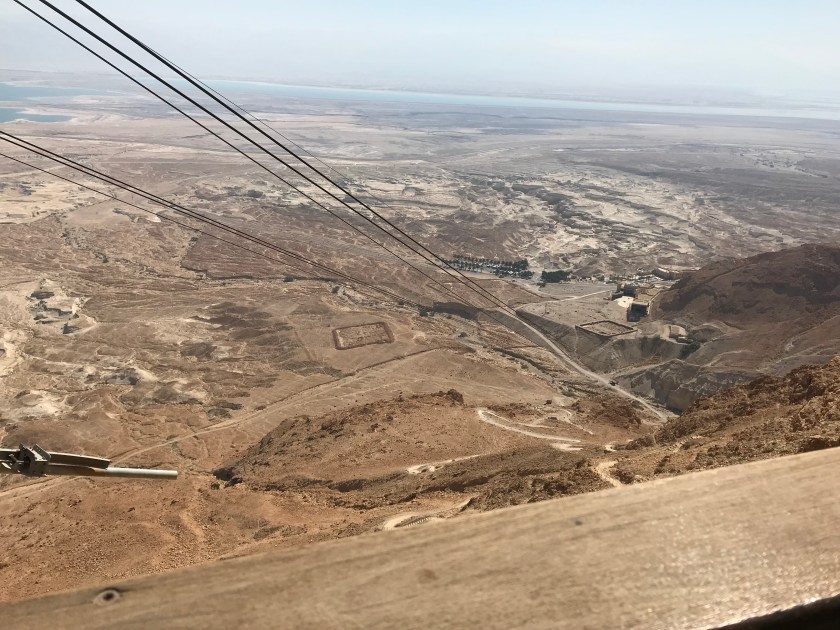
The fortress palace of Masada was built by Herod on a horst, or mesa, and was famously the site of the final battle of the Jewish rebellion against the Romans. We took a cable car up to the top about a hundred meters above us. Some people were hiking The Snake Trail up the sheer cliffs; I was glad for the tram. In ancient times the trail was heavily defended so the Romans built a gigantic ramp on the other side of the mesa, eventually taking the fortress – only to find the defenders had committed mass suicide rather than accept Roman slavery. There remained ample food stuffs for the defenders as food keeps well in this dry climate. In fact, a date discovered on this site from that time actually germinated and produced a tree!
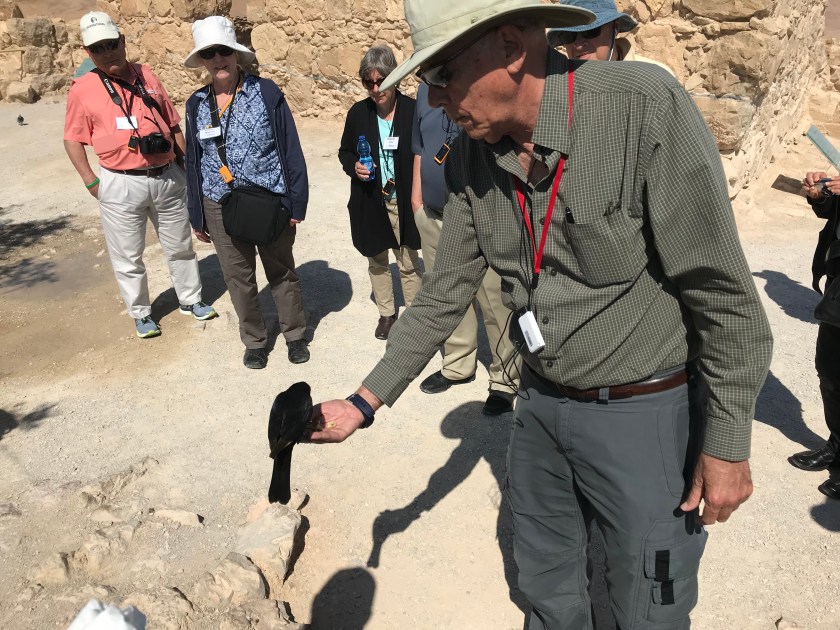
I knew the story of Masada but was unprepared to see how many buildings there had been on the top of the mesa. There were ruins everywhere including some later Roman ones. Some have been partially reconstructed giving a good idea of the extent of the buildings on top of this remote mesa. It does offer spectacular views of the surrounding hills and the Dead Sea. You can also still clearly make out the eight rectangular camps surrounding Masada, built by the Romans during the siege. We shared our tram down with twenty young Israeli women, all in green army uniforms; they were on a training field trip. Five or six of the girls carried M-4 rifles. I guess you cannot be too careful in Israel.
Our next stop was the ancient town of Jericho; ancient meaning it has been inhabited for over 10,000 years. The town of Jericho’s current claim to tourist fame is the ancient sycamore tree Zacchaeus climbed to see Jesus. It was not the same tree but it is very old. We were there for the shopping at a glass and pottery shop where we were served pita bread sandwiches for lunch. After lunch we drove east to cross the border into Joran at the Allenby Bridge crossing. Even though the crossing was not busy and we had VIP tourist status as a group it still took over an hour to get out of Israel and into Jordan. We changed guides to a Jordanian one, Fadi.
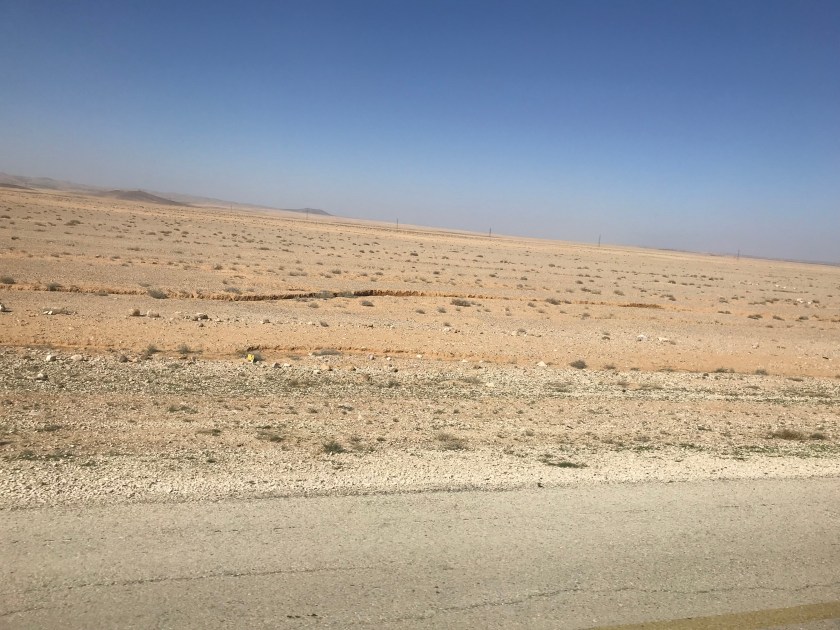
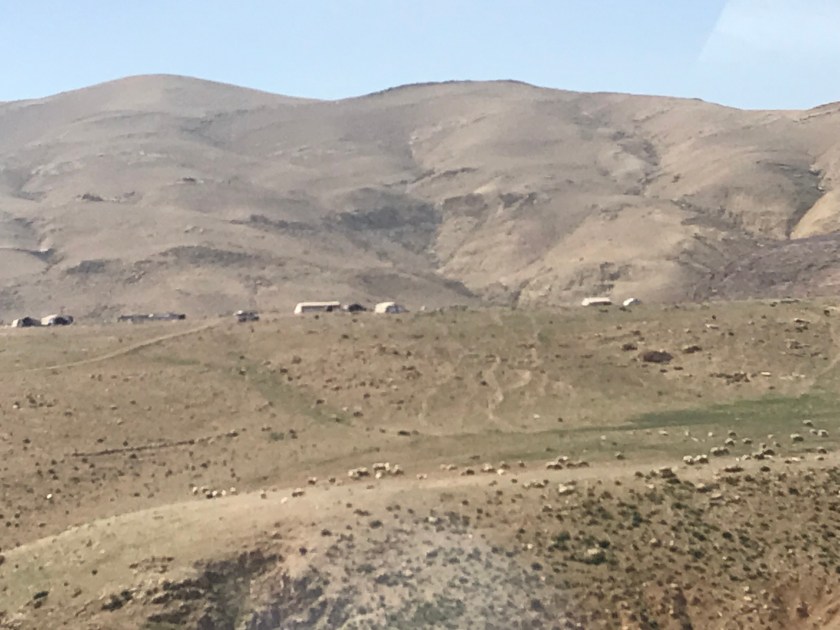
Jordan is very different from Israel. For one thing it is much poorer and the terrain is visibly more hostile. As is so often the case, when a place is poor it is dirty. There must not be a word in Arabic for ‘litter’ for we saw trash along the road more or less continuously. In addition to a few scruffy towns we could also see tents pitched out in the middle of nothing. It took me a while to realize that these were where people were living, without any services of any kind. So much for the glamorous life of a nomad. We drove south, with the Dead Sea on our right hand side and desert on our left until we pulled into our beautiful spa hotel, arriving mid-afternoon.
The previous four days of our journey had been busy and intense. It was nice to be able to simply relax in a luxury hotel with splendid views of the Dead Sea. The main attraction was the extremely salty waters of the Dead Sea which are said to have therapeutic qualities. It was a long, limpingly slow walk for me down to the distant shore. Because the water that flows into the Dead Sea is increasingly being used for agriculture, less and less flows into this sterile body of water. The water has nowhere to go other than evaporation. Thus the level of the Dead Sea goes retreats a foot or two every year. As I made my way down to the little beach I was relieved to see a number of my fellow pilgrims already ‘taking the waters.’ Many of them took advantage of black, black mud from a large amphora provided for guests to coat their skin with a covering. Alas, I had left my phone in my room and did not get an image them covered in mud. Actually, they appeared to be wearing a black wet suit.
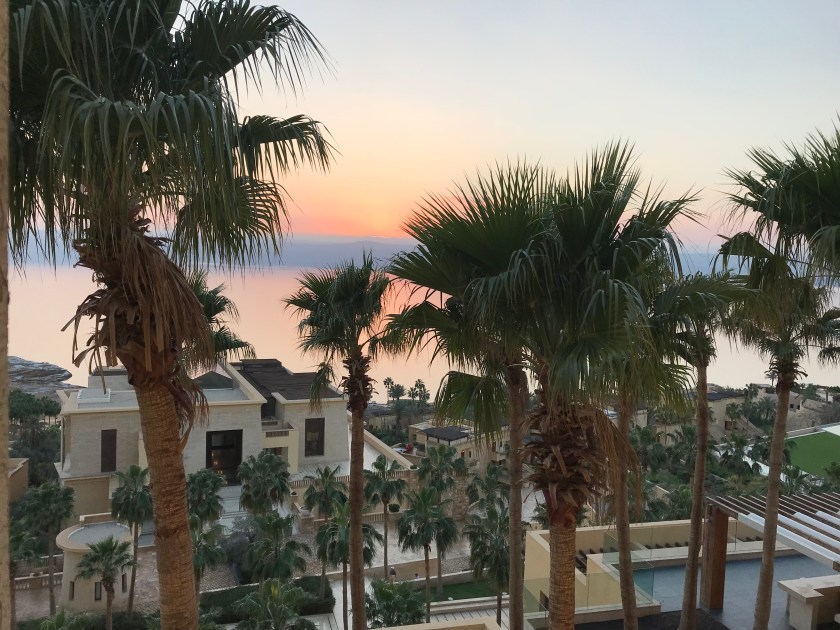
The Dead Sea is almost ten times saltier than the ocean which means you float very high in the water – weirdly so. Some of the ladies were floating placidly on their backs looking as though they were sitting on a hidden inner tube. I found the experience unsettling. For one thing, my injured leg was starting to act up after the long walk down to the water and was worried about falling face first into the water; I really did not want to get that water in my eyes. Even worse, I was having trouble adapting to suddenly being so buoyant. I have spent a lot of time in and on salt water and my mind just couldn’t adapt to this strange stuff that looked like the ocean water but definitely was not. I had to have help from my ever-helpful traveling companions to emerge from the Dead Sea after a very short stay. Looking at the long walk up the hill back to our rooms I decided to take advantage of a ride back in the hotel’s cart.
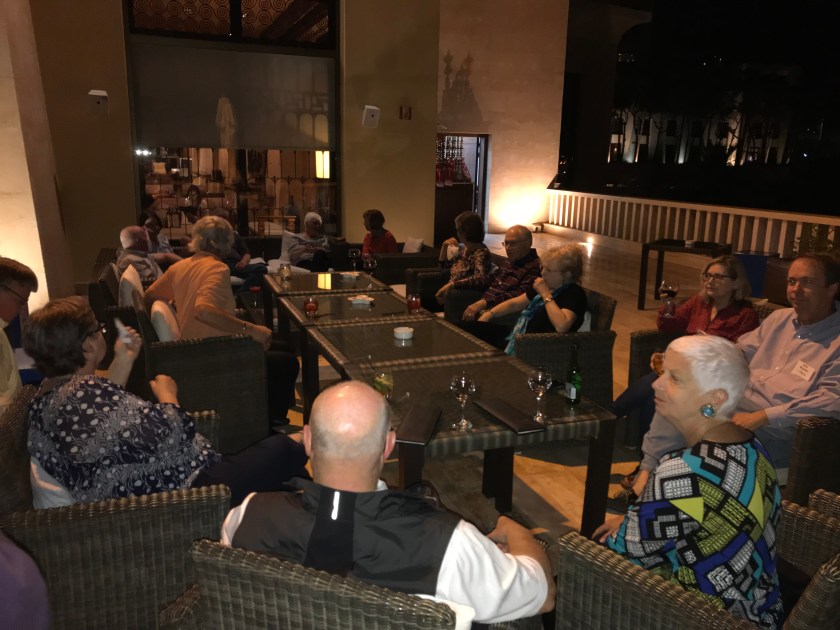
That night was absolutely delightful. The weather was perfect – cool, clear, and dry. We assembled on the spacious and comfortable patio for drinks before dinner, which was also superb. There was general agreement that we needed a ‘night off’ from the previous days which were so busy, and filled with deeply spiritual events as to be almost overwhelming. The next day would be completely different; we would be going down to Petra, a world heritage site.

The next morning we first paid a visit to the probable site of the baptism of Jesus. The previous site we had visited on the Jordan River was lovely and convenient. However, Jesus was baptized on the eastern bank of the Jordan in the wilderness. This place fits the bill perfectly; like west Texas, nothing much grows there and what does has thorns. This place has been a holy site almost from the beginning of Christianity. There are numerous caves in the low white cliffs surrounding the area where hermits traditionally dewelled. Because the land is so flat the Jordan meanders quite a bit and changes its course over time. We first hiked to the ruins of a church located on the former banks of the river.
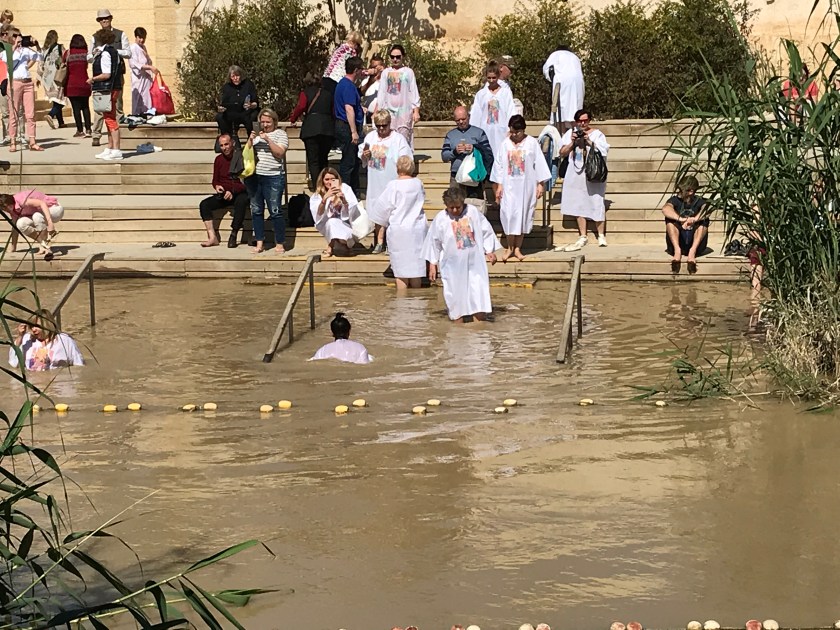
A short walk away there is another lovely Orthodox church near the banks of the current site of the Jordan. The Jordanian government has put up a simple ramada over some benches with a set of concrete steps leading down to the muddy stream of the Jordan. A bored soldier remained in the shade since the state of Israel was on the other side of the river. The Israelis, of course, had a very nice set of buildings with wide steps and guardrails leading down the river. They were doing a brisk business in pilgrims who had paid to come be baptized at this holy site.
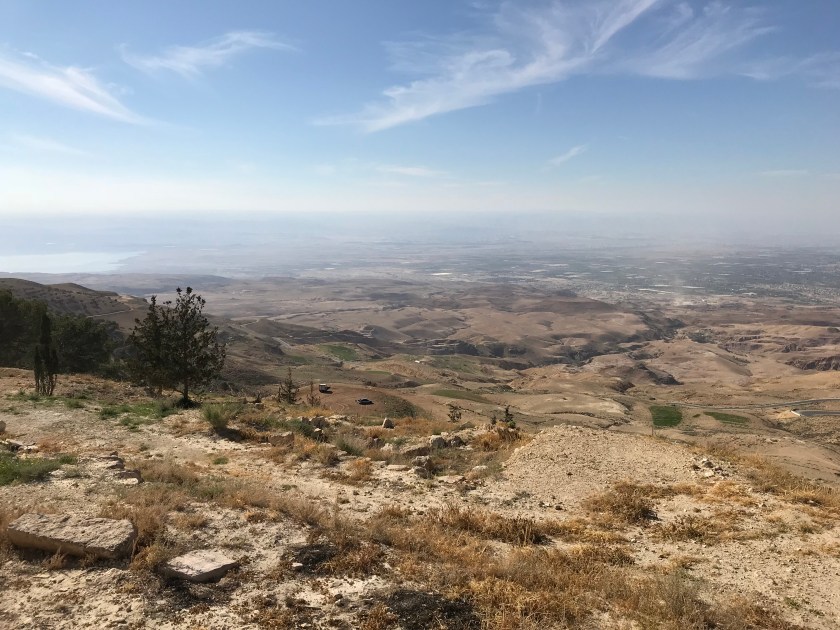
Our next stop was Mt. Nebo. In Exodus, Moses was said to have come up to this mountain to see the Holy Land that God would give to the Israelites. There was a splendid view. A lovely monastery was located on the site. After a stop at our guide’s cousin’s store selling mosaics we finally headed south to Petra. It was a long, slow drive. Saudi Arabia is providing money to upgrade the road through southern Jordan so there was a lot of construction along the 180 kilometers drive to Petra. It was long after dark before we got to our hotel. We checked in, hit the buffet, and went to bed.
The next morning we walked out of our hotel and right into the Petra Visitor Center. There were the usual gift shops, museums, shops and restaurants before we headed down Wadih As Siq which leads west, down into ancient Petra. I rented a trekking pole from a vendor for $5 – best money I spent on the entire trip.
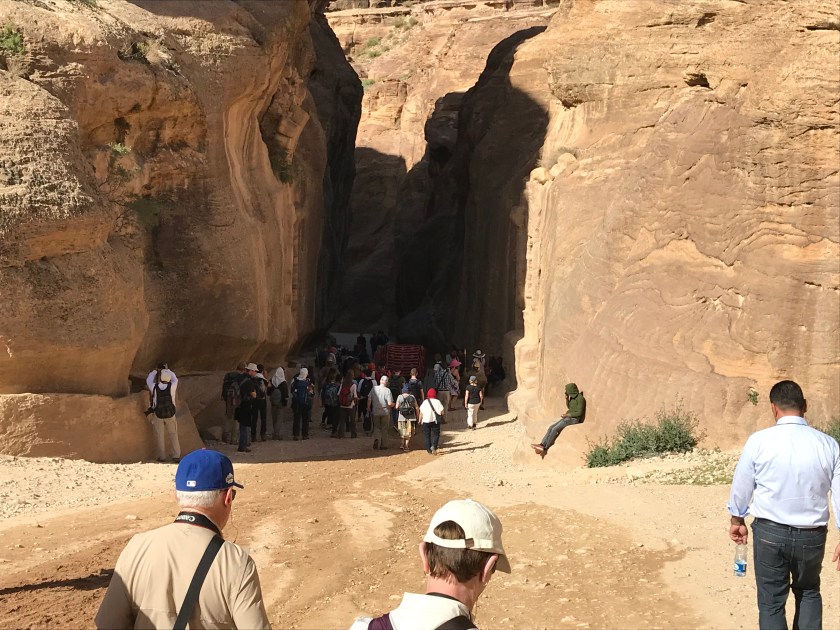
The entrance is through a gap in the rocks perhaps 20 meters wide. Until just over a century ago there was an archway over the entrance with a gate. Now, thanks to an earthquake, it is open, although two men in period warrior garb were there to provide ambiance and photo opportunities. The passage is a wonderful journey. About four kilometers long, this passage is simply wonder-full. The rock is relatively soft so the Nabataean people went to work carving tombs, residences, temples, and uncounted carvings into the rock. In places the trail opened up a bit to reveal tombs and temples cut into surrounding walls. There was some real engineering here too. The side canyons were dammed to prevent too much water from flooding the trail during the desert downpours. On both sides of the trail waist high troughs were cut –small aqueducts that at one time were covered by curved tiles. In one place a larger than life frieze had been cut into the side. Although badly weathered you could clearly make out men leading loaded camels. Petra was a world center for trade back then and had caravans of hundreds of camels arriving from east and west for transship onward.
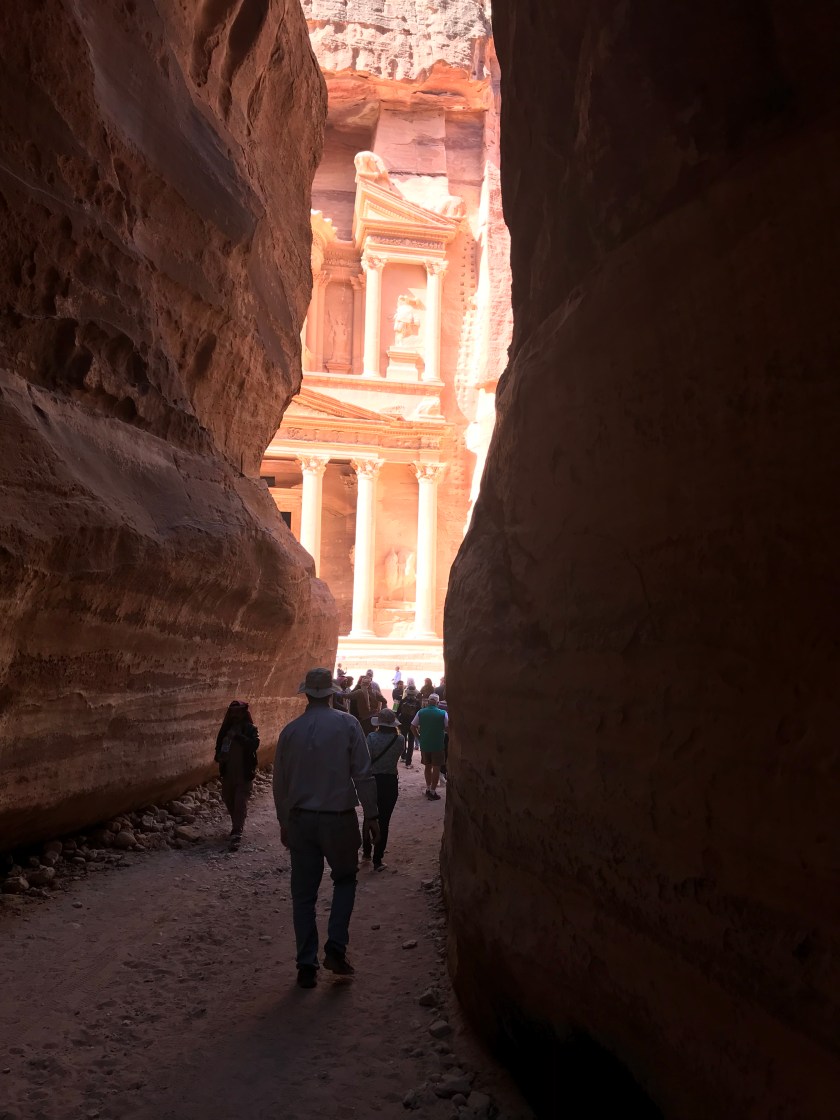
The end of the trail was incredibly dramatic. The trail was deeply shadowed. Ahead of us we could see where it entered a much wider cross canyon. The sun was shining down that canyon, brilliantly lighting huge high columns forty meters high. They were not build, they was carved out of the rock. Although called the Treasury, this structure, created a century before Christ, was a royal tomb.
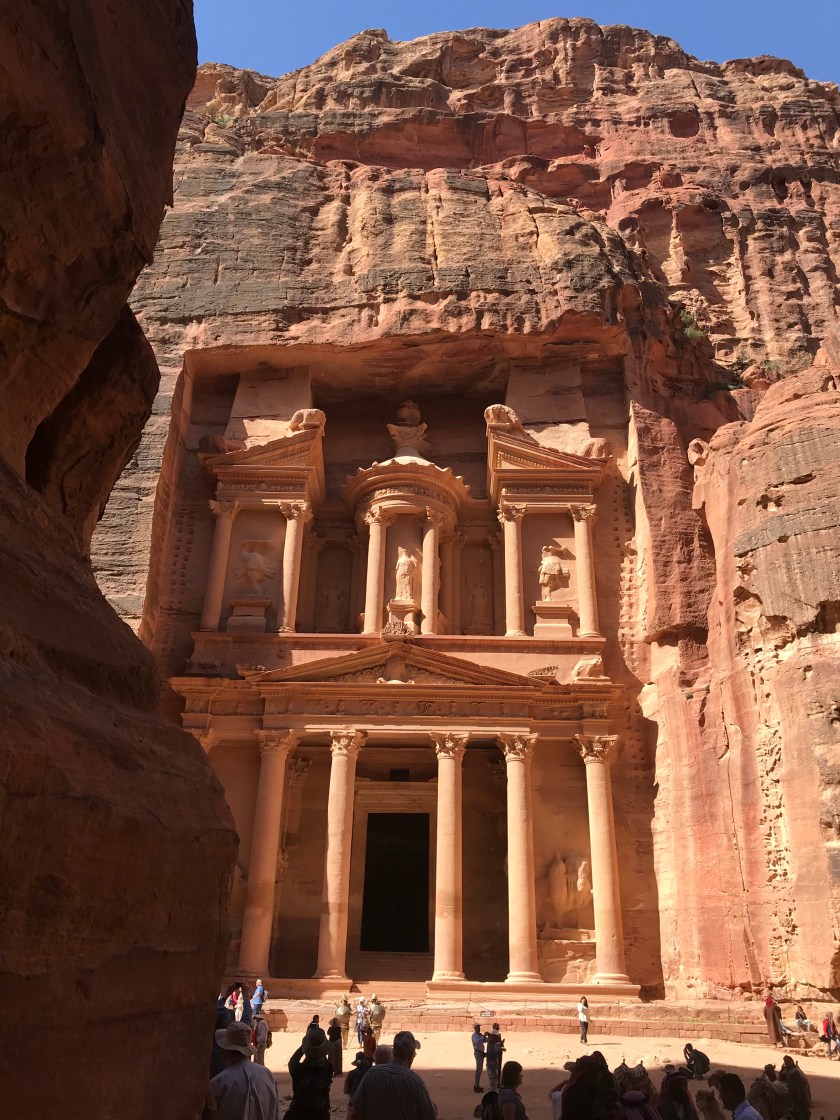
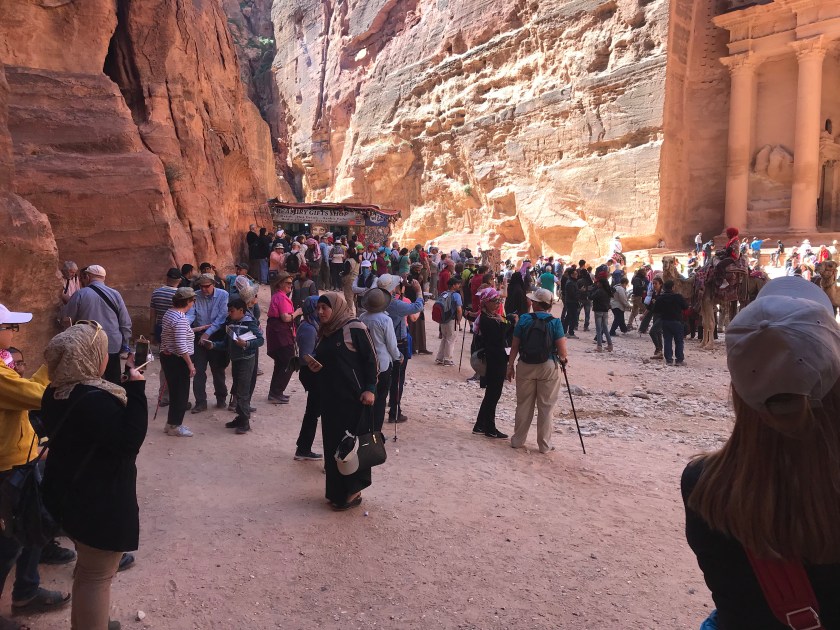
The cross canyon was about a hundred yards wide and was full of tent shops, tourists, Arabs selling things, camels, and wonder. There were many other structures all through the area. The main city had been a half mile to the right. Our group soaked in the ambiance, some even took camel rides. Eventually we wandered down the canyon toward other fabulous sights. Many of us took the stairs over to the High Place of Sacrifice which offered magnificent views of the ruins of the rest of the city. The way passed through the silk tomb which had swirls of different colors beyond the rose red of the rest of Petra. I eschewed the risky and arduous (for me) climb and had tea with my guide under a cool awing, chatting and admiring the wonderful gradations of color in the rock walls that surrounded us.
Locals live in state provided houses nearby. Local people make their living servicing the many tourists, but there are also goats and shepherds wandering about the ruins and innumerable caves. I was fascinated by the theater; the seats were of stone of course. When the Romans expanded it, the cuts at the back of the stadium revealed tombs which honeycomb the rocks.
John Burgon, a 19th Century poet described Peta thus:
It seems no work of Man’s creative hand,
by labour wrought as wavering fancy planned;
But from the rock as if by magic grown,
eternal, silent, beautiful, alone!
Not virgin-white like that old Doric shrine,
where erst Athena held her rites divine;
Not saintly-grey, like many a minster fane,
that crowns the hill and consecrates the plain;
But rose-red as if the blush of dawn,
that first beheld them were not yet withdrawn;
The hues of youth upon a brow of woe,
which Man deemed old two thousand years ago,
Match me such marvel save in Eastern clime,
A rose-red city half as old as time.

I would have like to have spent more time here but we had to be in Amman that night, 200 kilometers away. Some people rode back up in horse drawn carts. The clattering of their hooves on the stone trail, echoed between the high narrow cliffs gave plenty of warning as they charged past with wide-eyed tourists hanging on for dear life.
Our hotel in Amman was again an elegant five star place. We had a full up sit down meal for all twenty five of us at one table, which was unique for the trip. Yes, it was a luxurious place, but all I did in my big room was limp across the floor to pull the shades and drop off to sleep. Tomorrow we were going to Jerusalem.
 TBLOG
TBLOG 